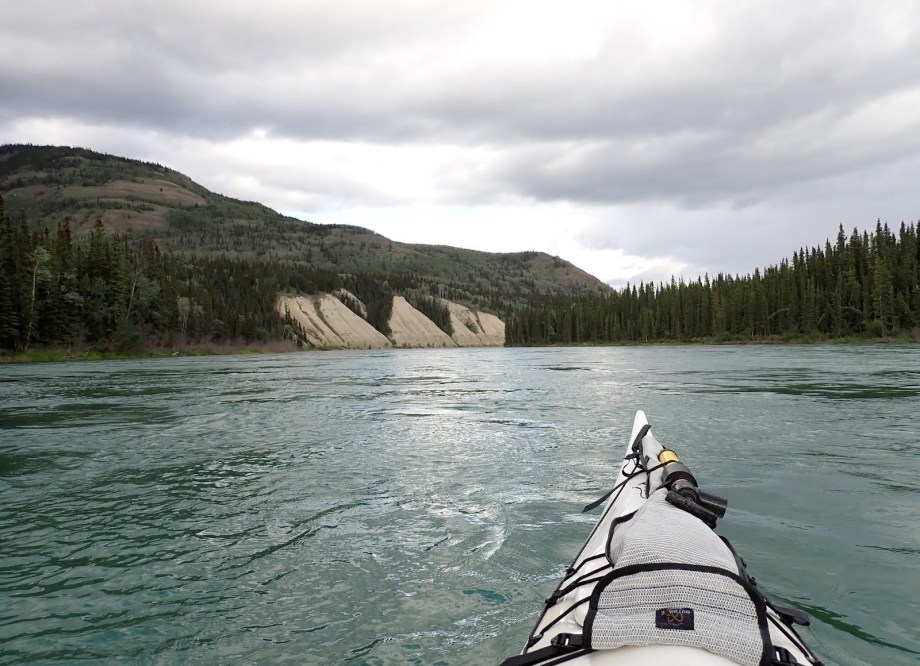
Whitehorse – Lake Laberge – Big Eddy Woodyard
The plan for day one is simple. Get through Lake Laberge and as far down the river beyond it as you can in a short day, with 15-16 hours of paddling time available after the 7:30 start.
[note: there was a lot of activity and a welcoming ceremony as part of the pre-start sequence – but I never got round to adding it to my first draft]
| Start line: | 60° 43′ 1.59″ N, 135° 2′ 48.87″ W (Whitehorse, YT) |
| Altitude: | 636.1 metres ASL |
| Start time: | 07:30:00 |
There’s a rush of urgency as you transition from casual strolling around Whitehorse, fighting off the effects of jet-lag to a solid day of paddling.
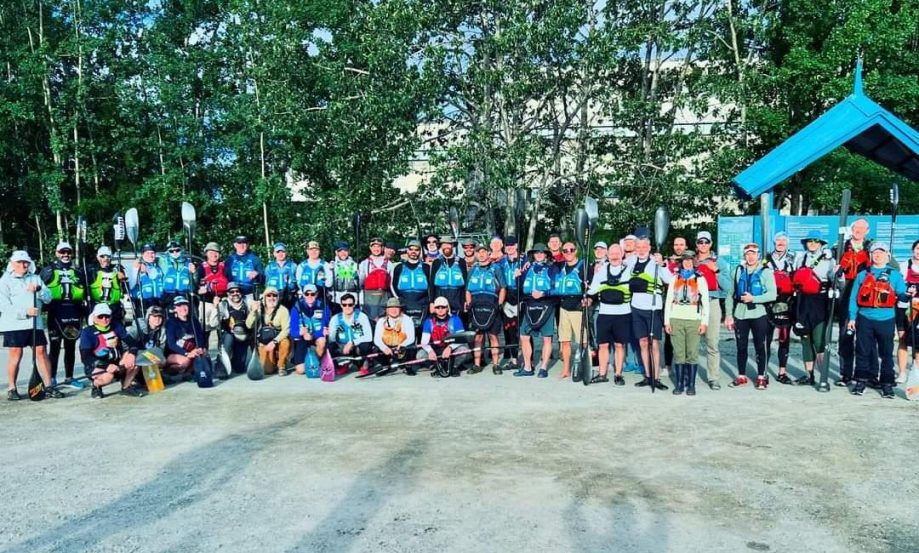
We’ve been told in the past that the race finishing order is decided by who leaves Lake Laberge first. I have some big doubts about the statistical accuracy of the statement, but I do think by the time teams have made it to the entrance of the lake (Upper Laberge @ 35km), you can see which teams can move a boat well.
Ignore the first few kilometres. There’s a mixed bag of behaviours at the start. Like any long distance race, some teams run to the water and charge off like it’s a 10km sprint. Maybe it’s the adrenaline. Maybe a desire to assert themselves early. We’re at the other end of the spectrum – take your time, avoid getting tangled up with other boats, make sure nothing is rubbing, and everything is squared away before going full ahead on both engines.
While we were concerned about position, we were counting how many boats we could see ahead of us to gauge our race position. We were close enough to the front that we could see them pulling away and by the 10-15km they would be out of sight, maybe for good.
There was a lot of jostling for position over the 35km to Upper Laberge. Teams would dig in to chase after a boat ahead. The chased team would dig in to maintain their distance. Little of it would be significant over the 1000 miles of the race, but the field was quickly settling into an ordered ranked by top speed.
There are only a few opportunities for creativity in the first section of the river to Laberge. You can choose either side of an island here and there, cut through the slower water on the inside of a bend, or run the longer path around the outside while staying in the current. River running is a constant calculus of speed vs distance. Does the shorter slower path get me through the bend faster than the longer path with more current. The answer is somewhere in between, cut tight enough to reduce the distance, but not close enough to put the boat in shallow water where it will develop bottom drag. Guessing how close you can cut on an unfamiliar river is often a matter of reading the river banks. If the banks are tall and vertical, the water will be deep, where there is a long gradual grade to the water and a beach, it will be shallow.
Shallow water causes bottom drag (where the wave created by the hull bounces back from the bottom and acts like a hill you have to try to climb over) and bottom drag slows the boat. The final variable in the equation though is how long are the shallows. While shallows will slow a boat, there’s a lot of momentum to overcome first. If you’re going fast enough, and the shallows are short enough, you can blast through before your speed is terminally impacted1.
Get the cuts right and you can shave a lot of distance off a river as wide as the Yukon. Get one wrong and you can burn a lot of energy in slow dead water, or worse, actually run the boat aground on a shoal.
For me, the cuts provide a distraction from the monotony of the river.
We made a couple of good decisions, and no bad ones as everybody settled into their rhythms. Early in the race is one of the few times you can duel with other teams, taking a tighter, or a faster line, and seeing how your pace compares, conscious that they may have seen your move and lifted their pace to make up for your better line.
Some teams who made a fast break were being steadily overtaken by more efficient teams who went off with less urgency. Tortoise and hare stuff.
Race your own race: Don’t get drawn into a head to head race with another team. You’ve trained at a pace for the event. Stick to your plan. Another team that appears faster might be faster, or they might be inexperienced and about to blow up. They could even be really fast and they’re just screwing with you to see if they can wear you out early.
One of the teams, we recognised as “the adventure racers” had made an early break, but were now pulled over on the riverbank, getting out of their boat. A shouted response to a shouted enquiry had sounded like “we’ve just broken our second paddle”. We wondered if this was Team Epic, and if so would they be regretting their choice of sponsors. We continued own the river speculating on how a team would deal with two broken paddles.
It’s not on the mandatory equipment list but we were packing a spare paddle on the front deck of our boat. It’s a reasonable risk mitigation against breaking a paddle over 1000 miles of remote and rugged river. That would deal with breaking one paddle, but what to do if you broke two? All three of our paddles are two-part splits, so we could presumably, hopefully, take two broken halves and fit them together as a mismatched franken-paddle. It wouldn’t be great because our three paddles consisted of a Jantex Gamma Medium which I was using, a Jantex Gamma Rio Medium for Kate, which was the same size but with a slightly different blade shape, and our spare was an older Jantex Gamma Rio in Medium Plus. Putting together a paddle from the unbroken halves of two other paddles would probably leave us paddling in circles. That’s assuming we didn’t break the same male or female end of both paddles.
That thought gave us something to talk about for the next half hour as we war gamed our solutions to such an unlikely problem. Our final conclusion was that it would be very concerning to break two paddles in less than 20km and the other team were probably rueing their choice of paddle manufacturers with 5 miles down and 995 to go.
Or had they said “pedals”? That kept us talking for another half hour.
The teams we could see were quickly thinning out and it was good to have something to talk about.
A few kilometres from the entrance to Laberge, we were among a loose collection of four other boats. There were the two Kiwi guys in a double kayak and a couple in a canoe we’d later identify as the Brodersons, a UK father-son pair in a kayak, and a couple of mates from the UK in another rounding out the teams we could see. Most of the teams were taking a traditional line around the outside of the bends, but one of the UK teams seemed to be following our shorter line.
Time for some mischief perhaps?
We’ve plotted a number of shortcuts on our course, and we would use them to good advantage against faster teams who might not have the river reading experience. Over the years we’ve had a few teams follow us into shortcuts causing us to lose our advantage. We’ve learned that the best way to avoid being shadowed it to provide some early discouragement.
With the river following a long westerly bend out on our left, we lined up a shortcut to the right of a large low island. Our chosen line positively screamed red flags with low land contours either side, ripples on the water characteristic of shallow water and even a few branches poking up, but I was convinced I could see a line of water that was flowing, which would be scoured deeper by the water.
Running a boat through shallows is a mix of art and science. Pick your line carefully. Lower your paddle angles to make them more effective in shallow water, and keep the boat moving fast enough that it’s riding on the cushion of its own bow wave. Too fast, or too slow and the boat will lower in the water and you’ll start to drag on the bottom.
The Yukon riverbed is a largely mix of gravel and silt. Bottom out on the gravel and you’ll scrape the boat – we didn’t care because it was our boat, not a rental – but bottom out on silt and you risk glueing the boat to the bottom. If you do come to a stand still, better to be climbing out of the boat onto gravel than sinking into a foot of sucking silt and potentially losing your shoes.
We had a few nervous moments as the river shallowed, but we jinked along the path of the flow to emerge with about 100 metres improvement on the teams who had gone wide, and glancing behind us, our shadow had failed to find the deepest water and had likely lost 100 metres, and hopefully any enthusiasm for following our line.
With the river opening up the western bend flowed across our path into a long Easterly bend which flowed out onto the lake.
Feeling a little frisky after success on the shallow cut, we2 decided on one final bit of navigational rebellion before facing the lake. Rather than taking the main flow onto the lake, we drove perpendicularly across the flow to where the skeletal remains of some old salmon traps poke up from the riverbed, then took a shorter but slower channel out onto the lake. This time the decision wasn’t based on shorter distance or potential jostling with other teams. Our channel would bring us onto the lake at a point about a mile west of the other teams, giving us a different line down the lake, one that we hoped would be closer to the wind direction which was from the South-West.
In both the Yukon 1000 and its shorter sibling the Yukon River Quest3, teams and organisers languish on the hazards of Five Finger Rapid which we would face on day 3 of the 1000. We’ve consistently said to anybody who asked that the 60 km of exposed water on Lake Laberge is much more concerning than 20 seconds of bouncy-bouncy and the need to pick the right4 channel through Five Fingers.
The rapids might mess you up and spit you out like a cat, bored with a new toy. You’ll probably spend some time getting your boat to shore and collecting all your scattered gear, but it’s over quickly. Laberge will chew on you like a postman’s leg for as long as it takes for you to get the the outflow.
As you enter the lake from the river, time slows. The excitement of the race start is 35km and 2 hours behind you. The energy of the current dissipates into the lake and the boat, laden with gear for 10 days in the wilderness settles into the dead water of the lake.
The distance to the shoreline removes the sensation of speed from forward progress, the distant objectives seem to never get closer.
Laberge is a flat water grind, and you can expect it to last at least 7-9 hours.
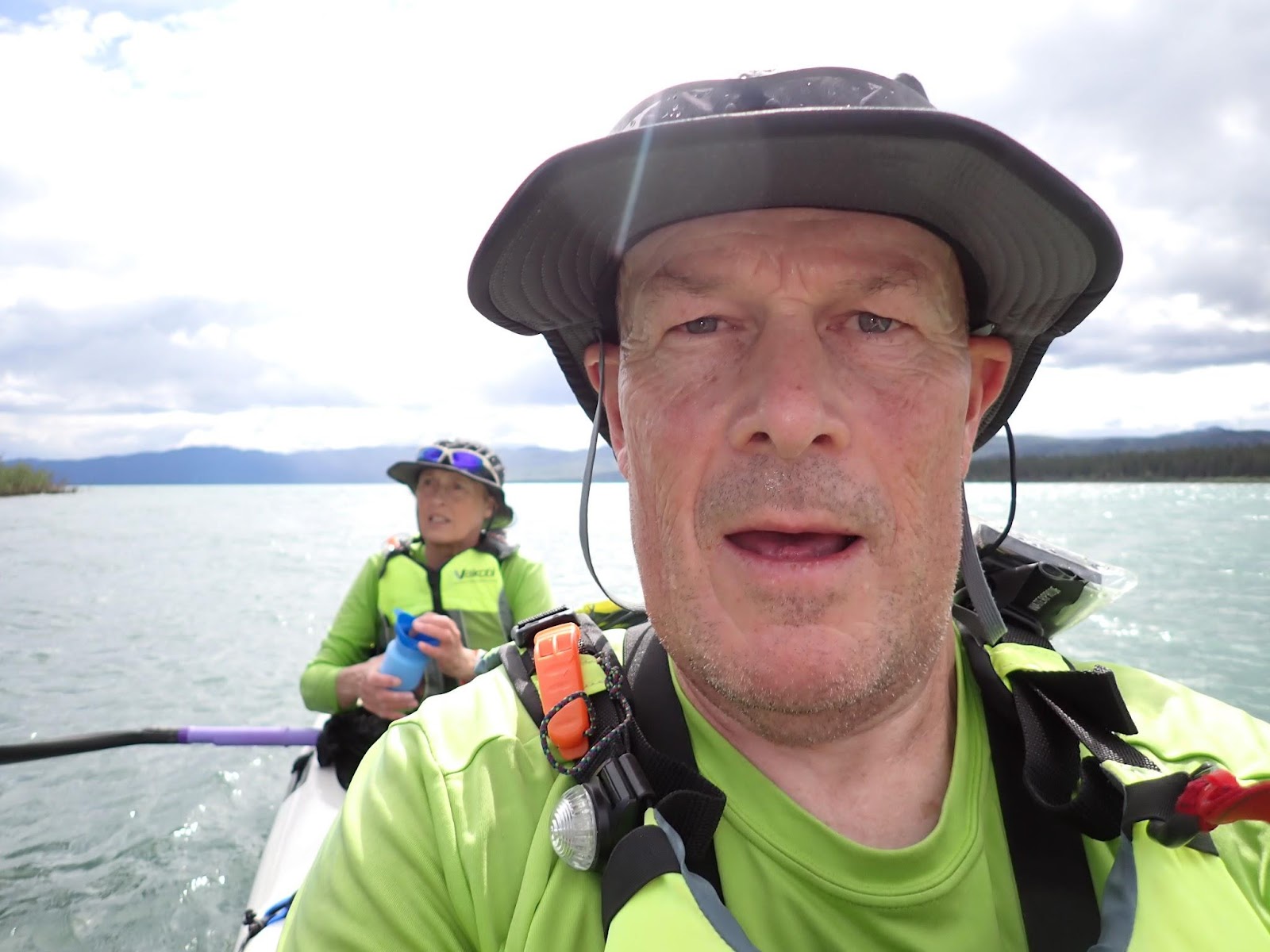
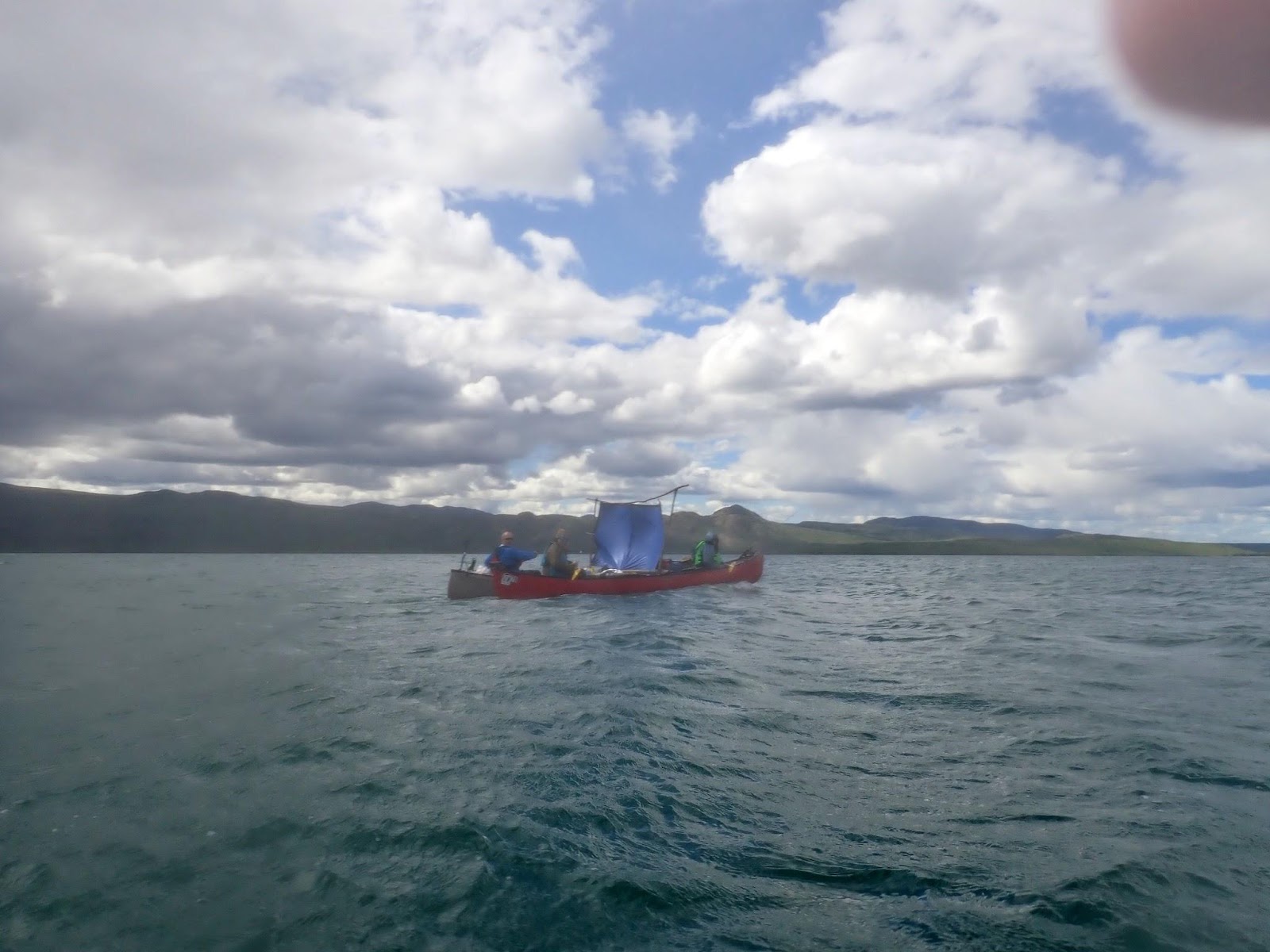
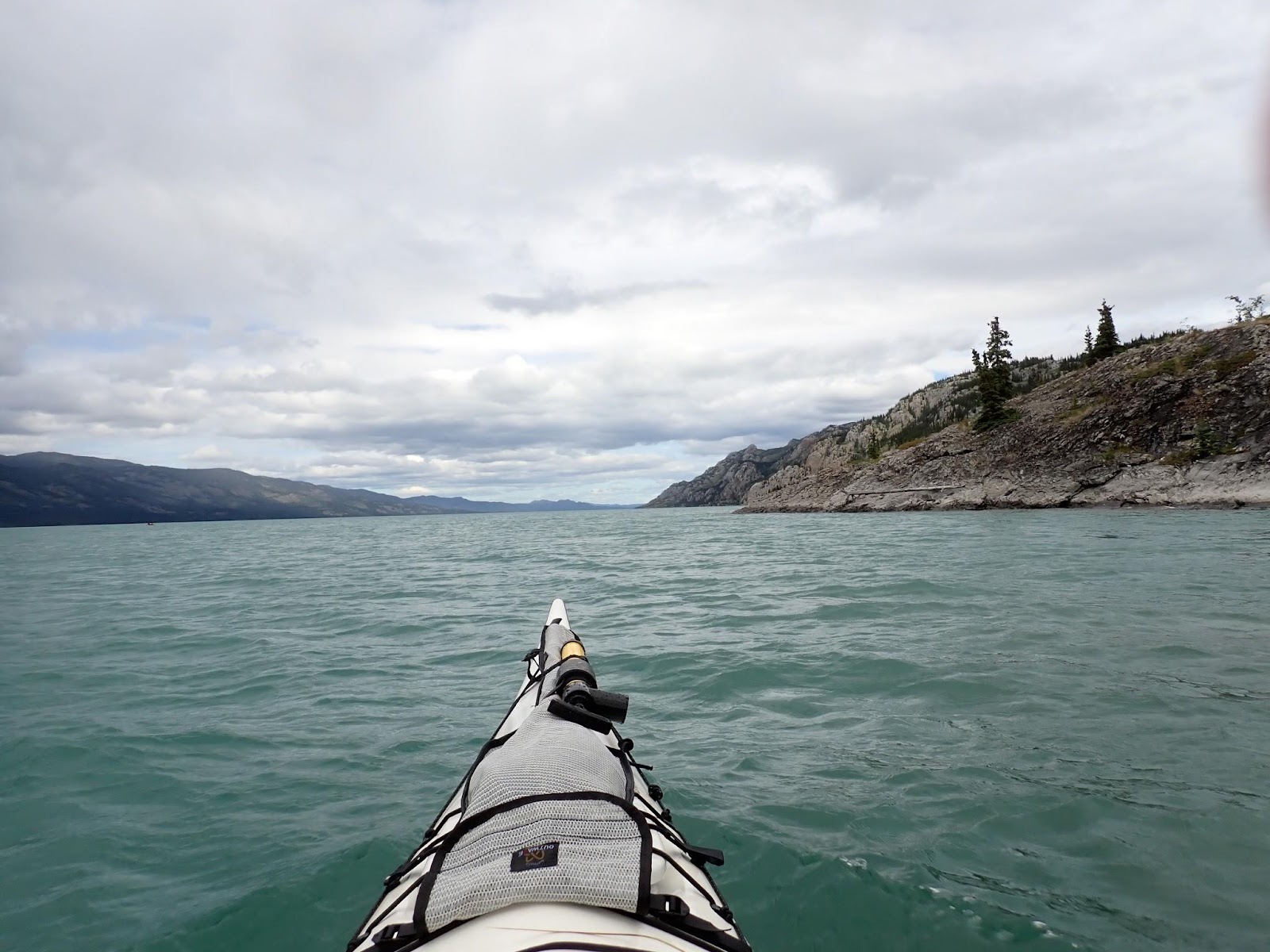
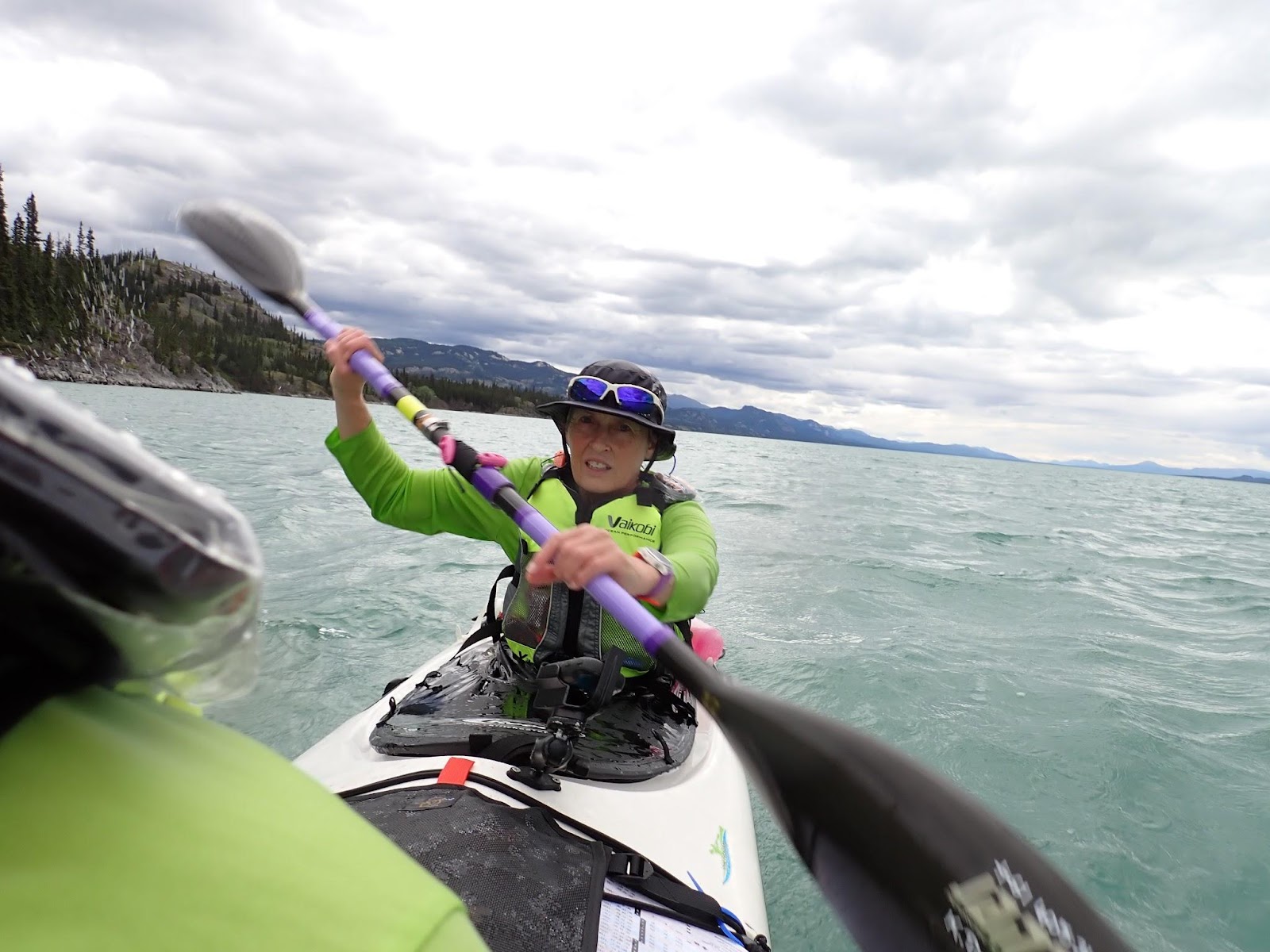
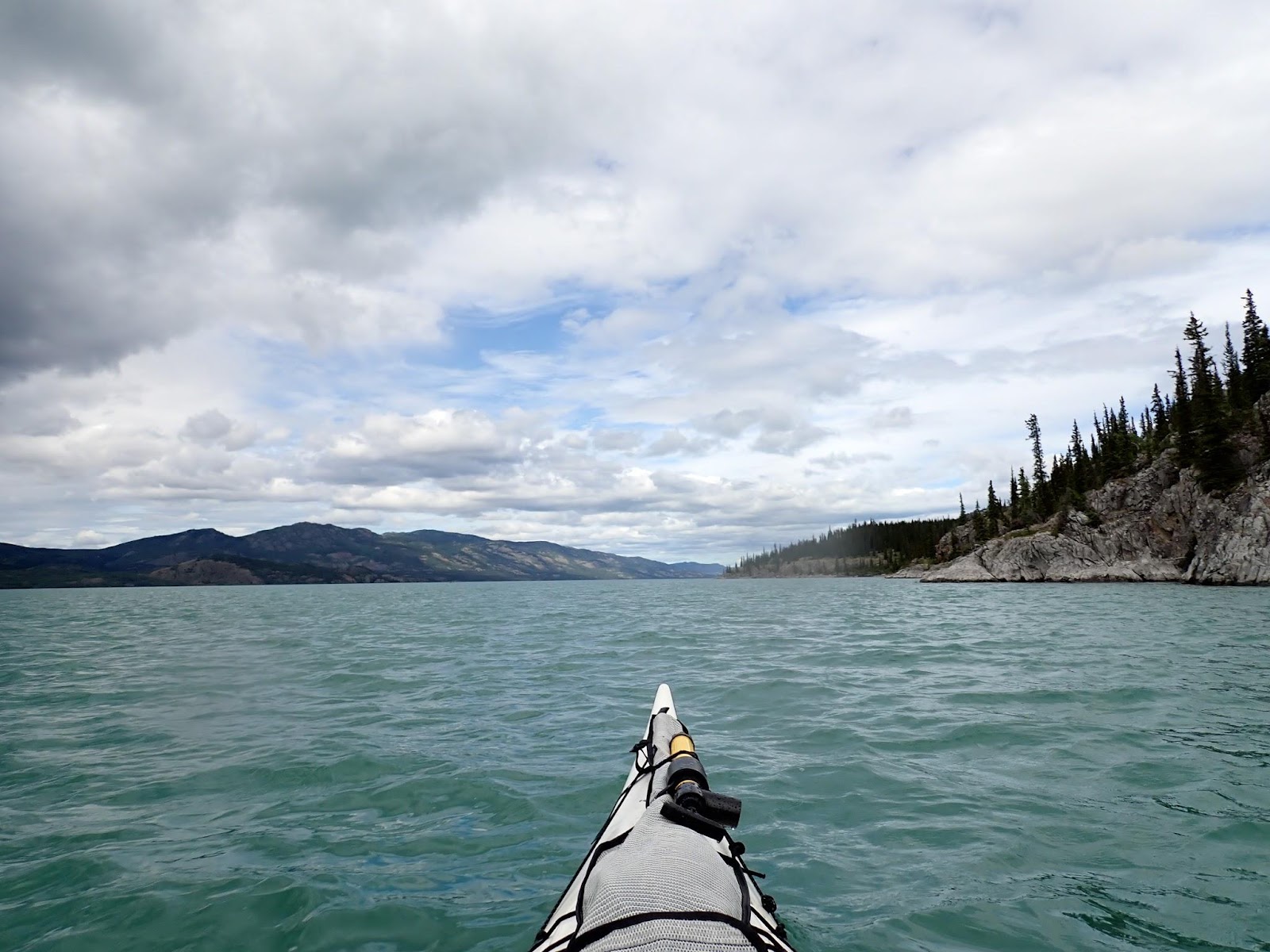
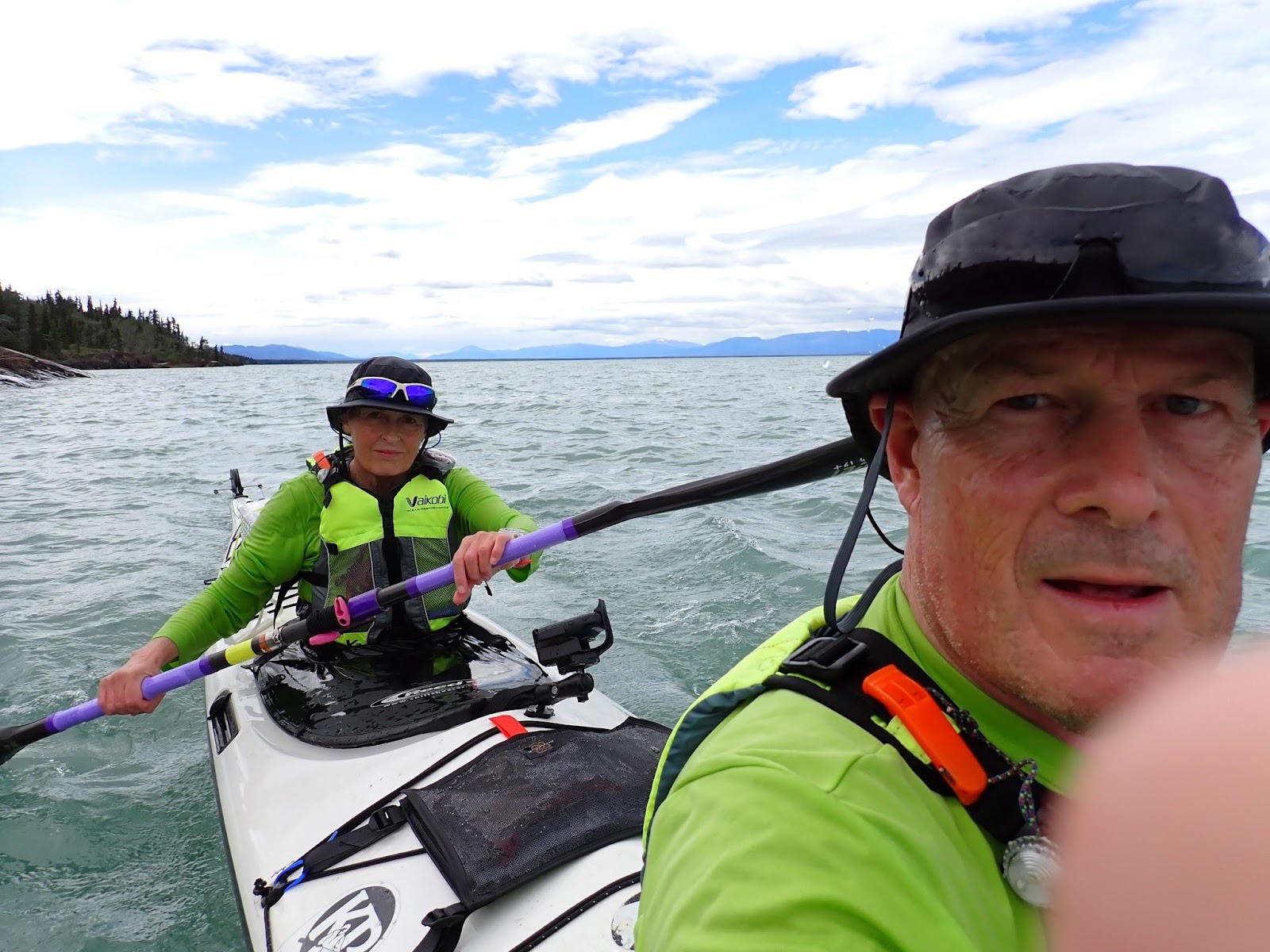
Having just set the expectation that Laberge will be flat water, it’s often not. With a large expanse of water and strong winds possible from any direction, Laberge can develop some pretty interesting waves.
You night be lucky enough to get a truly calm day on the lake, like we got in 2023. There was a slight ripple of wave from the South which was just enough to give our boat a bit of lift and push us down the lake a little faster. In 2019, we saw a level of ferocity that would forever put Laberge at the top of our risk focus, with 3-4ft waves smashing into us from the North-West and swamping boats throughout the field. The mandatory spray decks were no protection from waves that were hitting paddlers at chest height in canoes.
Our lake strategy was to get down the lake as quickly as possible before any conditions could develop. Our consistent experience has been that the conditions generally start as benign and build to whatever they want to be during the day. The longer you take, the more weather you’re going to see.
The potential conditions on the lake are the reason behind the rule that teams should stay within 400m of the Eastern shoreline, basically swimming distance, although that’s further than I’d like to swim pulling a swamped double kayak. Unlike the YRQ, the 1000 has no safety boats patrolling the lake. If you run into trouble you either sort yourself out, hope one of the other teams can assist you, or you push the big red button on your emergency beacon and hope that they work when they’re partially submerged in water5.
Note: If you’re hoping for a rescue by another team, it’s only going to come from teams behind you as everybody is looking forward, and also that the chances are seriously diminished if you aren’t on the path being used by the following teams.
The 400m rule is covered in the safety briefing, and makes a lot of sense. It’s also largely ignored by most teams.
Firstly, it’s quite hard to estimate distance across water. Even harder when there are no recogniseable scale signals like houses or people on the shoreline.
Secondly, if you were to follow the Eastern shore precisely, you’d need to go into all the bays and coves along the way6, so the briefing comes with the practical advice to ignore the bays and just stay within 400m of the main points. That will keep you, generally, within about a kilometre of the shoreline for most of the lake, but it does leave a lot of room for interpretation. One team might follow the two dozen or so outcrops along the lake shore, only to find that another team had interpreted “main points” as the two or three that allow them to stay on a much shorter course.
Thirdly, it’s a race, so if one team takes a direct line up the lake, any team chasing them will take a similarly wide line. We’d been guilty of that in 2023 when we’d taken a very direct line up the middle of the lake in pursuit of two teams we could see ahead of us. When we got close enough to make out details, we discovered that the kayaks were actually powerboats belonging to fishermen. The lead teams were well to our east where they were supposed to be.
A fourth confounding factor is that I honestly believe that 90% of the teams don’t know what a metre is and the rule would be better served if the distance was expressed in Freedom Units like 1900 Bald Eagle Wing Spans or 65 F250 Pickup parking spaces.
Our westerly entrance to the lake gave us an excuse to ignore the first large bay and head down the lake on a fairly efficient line to the first major outcrop.
Consistent with our plan for a conservative finish and perhaps still carrying a little guilt from drawing some other teams deep into the lake last year, we’d vowed to play nice with the rule this year and as much as possible hold the 400m course. We were also conscious that with two SPOT trackers per team this year, we wouldn’t be as invisible as we had been in 2023 when our SPOT tracker had gone offline for the entire lake. Jon handing out time penalties to transgressors, was a vague consideration.
Don’t white-knuckle the lake: Aside from the advice to paddle at your own pace, give serious consideration to chilling out on the lake. White knuckling is when either intensity or anxiety cause you to tighten up your grip on the paddle. Whenever somebody asks how to avoid blisters from paddling – after the inevitable advice to use gloves (don’t) – they’ll be told to relax their grip.
You do not want blisters in the first 8 hours of day one. Relax your grip. Hold the paddle like you would hold a raw egg.
True to expectations, as we plodded down the Eastern shoreline, we could see other teams across the lake to our left. One appeared to be so far left that they seemed to be following the opposite shoreline (Ironic that the genesis of our team name “Your other left” is my propensity to call out a direction that’s unrelated to the one I mean, and here we were with another team on the wrong side of the lake). Following close behind them, but closer to us, were the canoe team of the Brodersons. There were a handful of other teams out wide, slightly further back.
And the lake was starting to stir. The gentle wind from the South West was picking up and starting to push the waves down the lake. Our boat was handling it well and we were picking up a little speed from surfing the waves, but we knew from past races that some of the other teams would find their faster boats a bit of a handful over the coming hours.
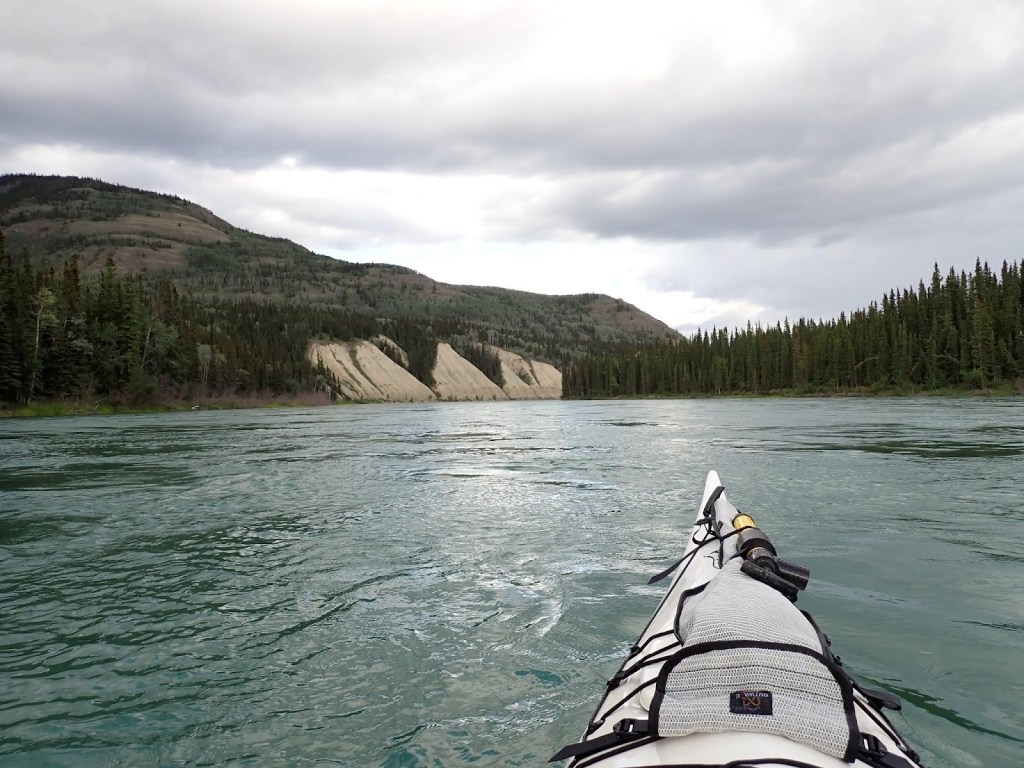
By the time we had the Lower Laberge exit in our sights the waves were about 2ft high and coming diagonally across from behind us. We had been watching the Brodersons out wide, knowing how much skill and nerve it takes to pilot a canoe in those conditions, they have our respect. The kayakers they’d been chasing had been forced to take a long line across the lake to bring them back to exit. That had put them in the middle of the lake for a long stretch at its most chaotic reach. We thought we recognised them as a pair of adventure racers who were quite new to paddling. Sometimes you may be better off not knowing.
We probably had a better time on the lake than the teams in the faster boats, but we were still happy to make the final turn back into the river at Lower Laberge. We’d covered 95km, in a touch under 9 hours, the current was about to give us a boost in speed and we weren’t one of the teams still out on the lake where conditions appeared to be deteriorating steadily (Jon had suggested that some of the teams would spend their first night on the shores of Laberge).
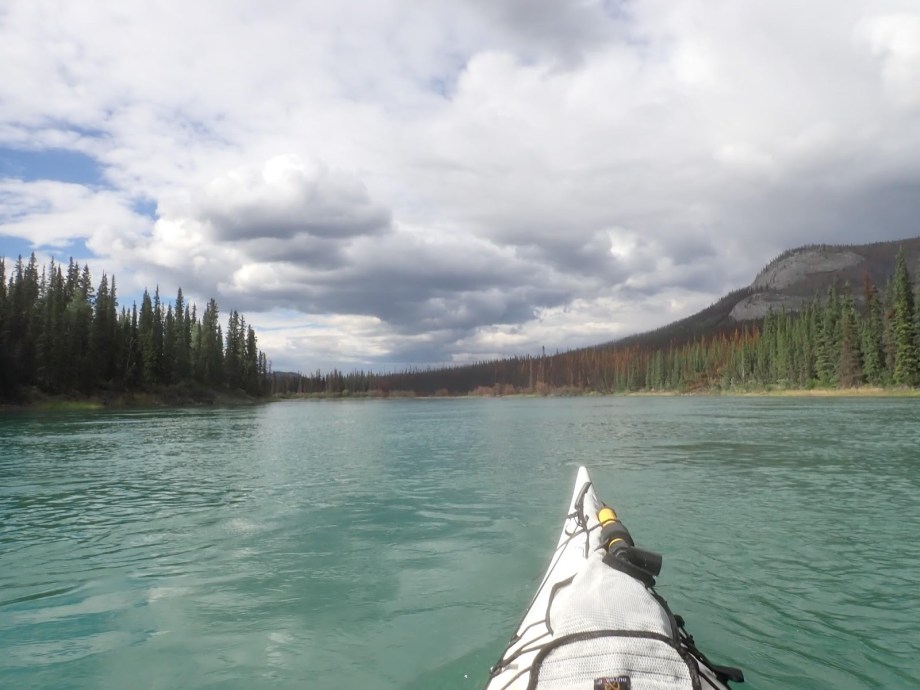
As well as the current, the river also provides instant shelter from the winds. The contrast with the conditions on the lake serves to accentuate the stillness and directness of the river as it winds through hills lined with trees. We were feeling good. What we consider to be the biggest hazard of the race was behind us and we were running about 7th overall, if we were right about the running count of boats ahead of us before we entered Laberge.
Over the next 5 and ¾ hours we would wend our way through the twists and turns of the river until we decided we’d gone far enough for the day.
What surprises me looking back is that I can remember the lake section with great clarity, but the following river is just a featureless blur without landmarks. We saw the occasional beaver and some bald eagles but that might have been on day one or day two. There are very few things to anchor the memories to.
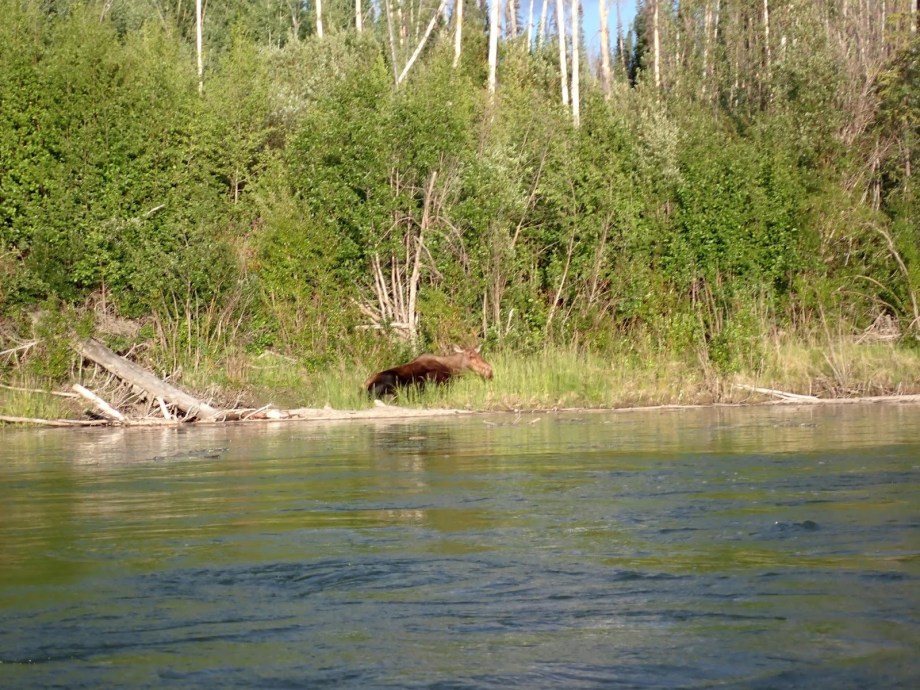
As the 10-11pm stopping window approached we began scouting the banks for potential campsites, not because we intended on stopping early, but to get our eye in for the sort of terrain that would yield a good campsite and also to get a feel for how often they were likely to appear.
In 2021, we paddled the 2400km length of The Murray River in Australia over 48 days and evolved our own system of scoring campsites.
It starts simply enough with a clear spot big enough for the tent +10pts. Deduct points for missing footage until there isn’t enough space for two sleeping bags.
Level ground is worth +10 pts. Deduct two points for every degree off-level. Double deductions if you have bumps that can’t be stomped down. No deductions for dips.
Grass under the tent +10pts. Sand +5pts. Gravel is zero points (this is simply the expectation). Mud or silt -10pts. Mud that sinks underfoot -20pts. Reeds or other marshy wet ground that is neither flat nor dry -50pts.
Where you pull the boat up is important. Water a foot deep onto a grassy bank +20pts. Gravel shallows +10pts. Deep water and a high bank – -20pts. Shallow mud or silt -50pts. Bonus 20pts if you can fill your water vessel from the current without getting your feet wet.
Finally there are super-bonus points for the thing that makes a paddling campsite great – the “black swan”7 feature – an orientation that gets both the evening sun from the West and the rising sun from the East, although it has to tick all the other boxes first.
For about 30 minutes we paddled past silty banks and tall eroded banks becoming resigned to either a sucking trudge onto mud or a gymnastic scramble up a 4ft bank.
But then we rounded a bend to find the best option we’d seen in hours. A flat wide grassy bank with good parking and the chance of catching a little early sunshine to help us get going in the morning. The only negative was that it was on the riverbank not an island, but we quickly agreed that the low scrubby bushes surrounding it were impenetrable enough to deter any bear that might wander aimlessly in our direction.
| Stop time: | 22:17:30 |
| Moving time: | 14:48:30 |
| Distance: | 163.3 km (101.5 mi) |
| Average speed: | 11.1 kph |
| Campsite: | 61° 45′ 53.02″ N, 134° 57′ 27.39″ W (5km short of Big Eddy Woodyard) |
| Race Position: | 8th8 |
| Distance Completed: | 101 mi |
Help encourage more posts by buying Steve a coffee…
Choose a small medium or large coffee (Stripe takes 10% and 1% goes to carbon reduction)
Or enter a custom amount
Your contribution is appreciated.
Donate- If you want to understand the science behind cutting corners, buy a copy of “The Science of Paddling” by Shawn Burke ↩︎
- by we in steering terms, I generally mean me, with Kate acting as a governing override on my more reckless steering decisions. Her advice is always well regarded, but I have the rudder pedals. ↩︎
- Yukon River Quest (YRQ) – 700km from Whitehorse to Dawson with two mandatory stops at Carmacks (7 hours) and Coffee Creek (3 hours). Even with those stops, it’s essentially a 50-90 hour non-stop race. ↩︎
- That’s right as in right-hand channel which also happens to be the right (correct) channel. ↩︎
- They don’t ↩︎
- You’d also be spending a lot of time at bad angles to the waves on the lake. Too close and you’ll have to deal with waves from open water and rebounding waves off the steep shoreline. ↩︎
- A black swan event is risk management speak for something that’s almost unthinkable – ironic that Australian swans are, as far as I know, black and not white. ↩︎
- we thought we were 7th and then another team went past us as we were setting camp ↩︎
 Rivers of Dust and Ash
looking forward to the next episode
LikeLiked by 1 person