
With limited annual leave available, we’d decided to fly into Whitehorse on the Monday before the race (Friday) and leave ourselves with some buffer days in Fairbanks at the other end, in case things went wrong1.
Thursday was blocked out for the race briefing and gear check, so we had two and a half days to get our gear sorted out.
Priority one was the boat. We’d bought a boat.
We’d come to Whitehorse twice before to race. First for the 2019 River Quest and again for 2023 Yukon 1000. Both times we’d rented World Kayaks 640 kayaks from Thomas at Yukon Wide. In 2019 Kate had been in the front seat steering2. She’d developed a fairly strong dislike for the setup and behaviour of the boat over the 700kms to Dawson. Returning in 2023 for the 1000, I got my own first hand experience of the WK640 in the 350kms before Kate had been forced to return the the front of the boat to steer us to Dawson. Now we both hated it3.
That was possibly the one thing we could both agree on during the day of our 2023 self evacuation.
It’s the steering, or lack of. The Yukon river is a big river with lots of curves and pushy cross-currents that you need to steer a boat through quite actively. The WK640 steering, just doesn’t. The rudder is too small and the keel is too straight. When you push forward on the soggy pedal the boat simply doesn’t respond until the its travelled a couple more boat lengths in a straight line. Then the turn begins. But this is not the moment for celebration. No, now that you’ve successfully added some turn to the boat and the bow has begun to edge its way towards yonder channel, or away from the impending collision with imminent rock, now is the time to stop the turn, because like kicking the tail of a brontosaurus, it will take a long(er) time for the boat to get the message you want to stop the turn. The natural path of a WK640 is a form of Brownian Motion, pushed hither and tither by random fluctuations of fluid dynamics. The only thing worse than a WK640, is a heavily loaded WK640.
You can recognise a WK640 paddler by the scars on their feet from trying to push on unresponsive pedals.
Our 2024 plan was no excuses, do what it takes to finish plan. We’d been ready to buy two matching EPIC 18X Doubles, one for the race and another to train in back in Tasmania. Josh and Julie had run one successfully in the 2022 Yukon 1000. Matching boats would have allowed us to customise and tune our training boat and then transfer it to the race boat. But that plan had fallen apart when Jon ruled the 18X unsuitable for the 1000. We did buy one as a training boat, and had our first unplanned spontaneous disembarcation4 in many years. Perhaps he’s not entirely unfounded on that front. We briefly considered doing the same thing with a WK640 but between the cost of shipping one to Australia and knowing that Thomas would never accept us modifying one of his rental boats, we crossed that off the list too. We figured we’d never be able to sell it in Australia, even with better seats, pedals, and rudder.
A couple of teams in 2023 had run Seaward Passats and while they hadn’t been in the first boats across the line, they’d all made it to Dalton with time to spare. Dan Voss had made a last minute decision to buy a Passat in Whitehorse, then traded it to a local Whitehorse paddler in return for having it picked up from Dalton. The catch with not renting your boat from Thomas is that you need to organise your own transport from Dalton. Thomas doesn’t transport other peoples boats (don’t bother asking, the answer is no).
Having crossed the WK640 and the 18X off our list, we bought Dan’s Passat and arranged for it to be stored for a year.
As the race start approached, we organised for our boat to be dropped off to Kanoe People who were going to help us move the boat around for pre-race shakedowns and to the start line on race day.
When we first saw the Passat sitting on a trailer at Kanoe People, we shouldn’t really have been surprised that it was looking a bit scruffy. The boat was sporting Yukon 1000 stickers from both 2022 and 2023. It had obviously gone straight from the finish line at Dalton Kanoe People via a basement in Whitehorse, without pausing anywhere for a hosing out.
We launched ourselves into the boat upgrades like a formula one pit crew. I’d spent several weeks building a set of upgraded foot rests. A simple plate for Kate in the back and a plate with steering pedals for me in the front. The foot rests had been built from fibreglass and carbon fibre working from a couple of photos and some rough measurements I’d been sent when the boat went into storage. I’d built the plates with some extra length in them so I could trim them to size when we finally got hands on the boat.
Our tool kit, another race requirement, had been carefully planned to include some extra tools we’d need to make serious changes to the boat. We would surely be the only team who were packing a cordless screwdriver, step drill, a collapsible hacksaw, and a collection of stainless screws in their repair kit, along with the usual duct tape, silicone, zip ties and spare rudder cable.
TIP: A Murray Marathon tip from the venerable Stewie Nicol. Wrap a few metres of duct tape around your paddle so that it’s quickly at hand when you punch a hole in your boat or need to quickly cover a blister. Bonus points for selecting a brand of tape that sticks to wet surfaces so you don’t need to dry your boat.
Over the next few hours, we replaced the foot plates; replaced the rudder cables with new dyneema lines, disconnecting the rear steering which we didn’t plan to use. We added GPS mounts to the deck. Re-tensioned the decklines and changed the layout to provide shock cord fixings for the sleeping mats we planned to carry on the rear deck. Cycling bottle cages screwed to the deck gave us easy access to our bottles of electrolytes. All up we drilled about 30 holes in the boat, so it was a good thing it was ours.
We’d considered changing out the seats for foam Bumfortables, but had instead decided to use honeycomb gel seat cushions.
We’d opted to use foam sleeping mats rather than inflatable mats for two reasons. Foam mats can go from the boat to the tent in a few seconds after shaking off any water. Inflatable mats might pack smaller, but they need to be inflated at night and deflated in the morning, and most importantly, if you puncture one, you’re going to have a really cold night when most of the campsites were on sandbars just above water level. The foam mats wouldn’t provide any relief from uneven surfaces, but they stop 100% of the cold which is the main thing, and being foam, they didn’t need to go inside the boat.
Tuesday was our designated day to test paddle the boat. Kanoe People took us out to a boat ramp on the Western side of Lake Schwatka 5 minutes out of Whitehorse. That was the first difference we noted between Kanoe People and Yukon Wide, who always used a boat ramp on the Eastern side which is a 20 minute drive. The second was that KP were on time5, for both the drop off and the pickup three hours later.
This was the moment of truth for the modified steering system, and it performed beautifully. The difference between good steering and bad steering is that good steering is something you don’t have to think about, you turn your head to look into the turn, and the boat goes where you’re looking. Meanwhile the other teams were at the lake trying to trim their WK640s to get them to turn when they were supposed to and go straight the rest of the time.
Our experience told us that if it was ornery on the lake, it would be exhausting on the river.
The one small oversight with the rudder pedals was that I’d used light metal hinges and they were already deformed from turning the long double on the lake. They were still holding, but considering the consequences if they broke out on the river, we decided they needed to be upgraded. We’d left Wednesday as our day for test packing the boat and doing fine tuning, so we added a side trip to The Home Hardware Store for some upgraded hinges and some bolts to fix them in place. It was an added bonus that we’d be paddling on fresh water so we didn’t need to find stainless steel fittings like we would back home. A few hours and the steering system was finished. We had no more time for test paddling, so we would just have to trust that I’d built it well enough for 1000 miles. In 2023, I’d jury rigged a foot bar from a set of wooden salad serving forks and some zip ties. That contrivance had lasted 500km before needing new zip ties and then went the remaining 200km to Dawson.
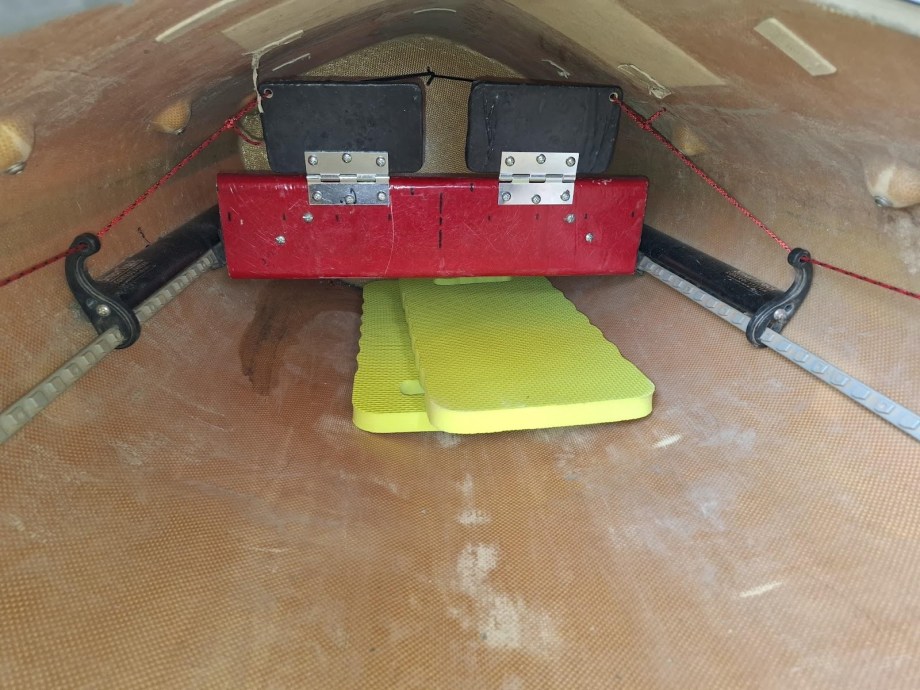
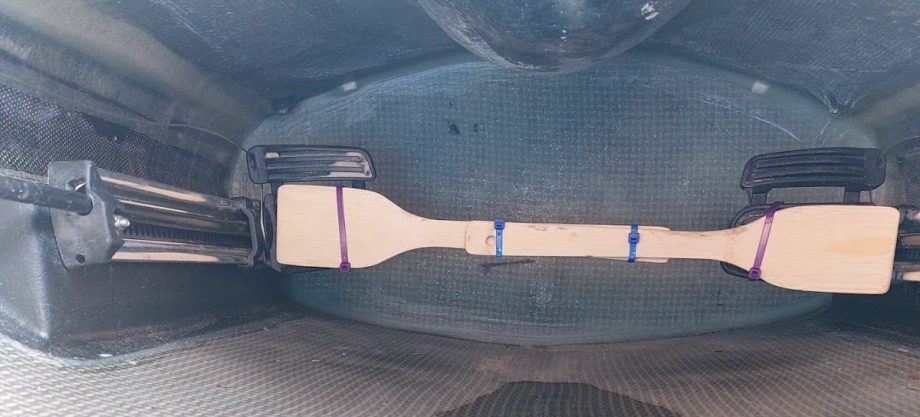
They might lack finesse and refinement, but screwed over the top of a set of adjustable pedals they were solid and simple enough to go the distance. For a once-and-done, we honestly didn’t care what the next person in the boat might think of them.
Kate had decided that she wanted a little extra height under her heels to get her position set up, so the final touch to customisation was a couple of $3 garden kneeling pads. What trip to North America would be complete without at least one visit to Walmart?
To manage our gear on the deck, we added a pair of low profile deck bags6 and paddle sleeves7 from Outware in Tasmania. They’d also made us a pair of custom gear bags which were large enough to hold all of our gear including paddles for our international flights and would roll up small enough to stow in front of the foot rests until we needed them again in Dalton. Being able to have our split paddles inside these two bags had saved us a small fortune in excess baggage fees on our international flights.

Formal race requirements started on Thursday, the day before the race. First up race briefing and a final few words from Jon. Largely it’s encouragement, sprinkled with dire warnings about the consequences of complacency. Mostly it had been covered in the mandatory team briefing notes issued months earlier, but it’s all stuff worth going over one last time.
We used our spare time to sort out the final items on the list that you can’t fly into Whitehorse with. Bear spray and bear bangers. Technically you’re only required to carry bear spray but we’ve read the small print on the can, so we choose to carry bear bangers as a longer range counter-measure.
Race briefing
Inevitably, there are some last minute changes. This year the evening stop time time would be between 2200HRS and 2300HOURS. In 2023 it had been from 2200HRS and 2400HRS giving us a more time to find a good camp site.
Expect last minute changes: It’s unlikely that the major equipment items will change, but Jon can and does change cut off times, sleep periods, and other aspects of the race based on river levels and changing conditions. The gear checks will probably change from year to year as Jon refines the process and addresses problems from previous years. Just roll with it, and try not to annoy Jon.
Being honest, there aren’t many (any?) good campsites. Posted campsites are verboten under the rules, along with settlements and cabins. It’s an unsupported event and you’re going to get grilled by Jon if your tracker stops for the night next to a 7-11. In selecting a campsite, your first priority is to get as far down river as you can. Second priority is somewhere you’re unlikely to encounter a bear. Gravel bars and islands with clear visibility in all directions are the gold standard.
Much further down the list are normal camping considerations:
Is it flat?
Is it dry?
Is there enough room for my tent?
Can I get out of the boat without sinking into mud up to my knees?
By the third night, flat and dry will have become meaningless terms. By the fifth, you probably won’t give a shit about bears either.
Another change was that Ben, who would be driving us from Dalton to Fairbanks at the end of the race was offering to take gear from Whitehorse to Dalton for a small fee. A much smaller fee than we’d just paid FedEx to deliver our extra bags ahead to Fairbanks, AK. The Portuguese team had been ahead of us at FedEx, so I guess they were similarly perturbed8.
Finally, we got to the slide we were most interested in – the cutoff times. There are two cutoffs for the race. The first is 700km downstream at Dawson City. It’s there to make sure everybody is racing9. If you don’t make Dawson in time, you won’t be allowed to continue. The second cutoff is at the finish line and is really just Jon’s way of saying he won’t hang around at the finish line beyond a reasonable time.
Each year Jon sets the cutoff times according to his assessment of the river levels and flow. Compared to the 2023 cutoffs, we’d have three more hours to get to Dalton, but five less hours to make the cutoff at Dawson. Let’s just agree that the formula is inscrutable and the Race Director can do whatever the Hell he wants.

Something that may have caught a few people unawares was the requirement to have our mandatory sat phones turned on for the 6 hours we were stopped each day. It adds complications to the electronics equation. If your phone is turned on for 6 hours each night, you’re almost certainly going to have to charge it at least once during the event. That’s why you’re also required to carry a solar panel. Having been surprised by this detail the previous year, and having later discovered that our solar panel was next to useless for charging a sat phone, we’d adapted our gear accordingly. We were packing a spare sat phone battery in addition to the two USB power packs we hadn’t been able to FedEx to Fairbanks. Whatever happened out on the river, we wouldn’t be stuffing around with an ineffective solar panel when we ran low on charge.
After the briefing, there’s a break of a few hours before the kit check.
Gear Check

The kit inspection process consists of all the teams standing around in a park near the start line with their kit, holding up items as Jon calls them out so he can visually confirm you have them. Woven into this is the somewhat lengthier process of confirming that your electronics are working. The sat phone is confirmed when you can successfully send a text message to Jon’s satphone10. The SPOT trackers are confirmed when they successfully appear on the tracking website. Kit check has been a little different for us from year to year.
In 2023 we had trouble with our sat phone. We’d opted for an Inmarsat phone which had more battery life and better waterproofing. The downside was that Inmarsat satellites are low on the horizon when you’re that far north (about 12 degrees above the horizon), so they became very problematic unless we had an unobstructed view to the SE or SW. We’d also discovered that our provider had toll-blocked calls across satellite networks because they would be too expensive – AUD$26/minute. The rules had been updated for 2024 and only Iridium phones are allowed now.
This year the most common team problems were with the SPOT trackers. They’re temperamental shits of things and when they aren’t working, there is very little you can do, other that turn it off and on and hope that it decides to play nicely. We prepared as best we could for kit check by turning our SPOTs on and walking them around Whitehorse with us while we did our prep work, at the same time checking the SPOT website to confirm that they were transmitting.
Each team member is now required to carry their own SPOT device and have it mounted on the left shoulder of their PFD11. Aside from the tribulations of transmission, the other contentious point of the gear check was how the SPOTs were attached to peoples shoulder. Jon was intent on making sure that they were mounted high, with the unit facing the sky to give it the best chance of transmitting a tracking signal to Race Control.
We had tried lots of different cases and pouches to get the SPOT positioned correctly on our PFDs. In the end we’d settled on a soft plastic phone case which could be rolled around it, and a few turns of electrical tape. It wasn’t going to make for easy access if we needed to change the batteries over, but it got us through the kit check.
TIP: Watch that you don’t tape or strap the SPOT around the power on/off button. The other buttons are all recessed, but the power button is on the edge of the unit and it’s easy to cause problems if you tape it without noticing. Jon might penalise teams who stop transmitting their position.
We did a quick test pack of the boat on our way back to the hotel from the kit check – sleeping bags and tents – confirming that the big awkward gear elements would fit into the required hatches. We were leaving it a bit late, but we’ve done enough expedition miles to be a bit relaxed about how much gear we can cram into a sea kayak. We’d be packing our boat with all of our gear for the first time on race day. The challenge of finding the right spot for each bit of kit, based on how often we’d need it, would be a welcome diversion in the nervous hours before the start.
Help encourage more posts by buying Steve a coffee…
Choose a small medium or large coffee (Stripe takes 10% and 1% goes to carbon reduction)
Or enter a custom amount
Your contribution is appreciated.
Donate- We were confident, but let’s face it, things had gone wrong before ↩︎
- I had been banished to the back seat indefinitely for some questionable navigation choices – 12:05pm December 26th, 2016 – involving a big swell and a small reef ↩︎
- Our dislike of the WK640 steering system is entirely personal opinion. Many teams have had success with the boat. Kate and I are used to paddling very different styles of boats, as used in Australian races. As a mixed team, we have a weight imbalance which also plays into the way the boat handles. ↩︎
- swim ↩︎
- To be fair, Thomas was always on time. It was his customers that made everybody late. ↩︎
- Deck bag https://outware.net.au/product/kayak-cockpit-bag-adventure-gear/ ↩︎
- Paddle Sleeve https://outware.net.au/product/kayak-spare-paddle-deck-bag-adventure-gear/ ↩︎
- It might be wise to hold off on sending your gear ahead to Fairbanks by FedEx, and there might be a chance that Jon will have free bear sprays to give away, so leave those tasks until after the briefing. ↩︎
- To quote the race organiser from the Texas Water Safari “if you can’t make it to the checkpoint by the cutoff time… Paddling is probably not the right sport for you. The times are very achievable, if you keep the boat pointed down the river. ↩︎
- Be aware this process can change. We pre-checked our satphone for text and voice calls from the hotel prior to gear check to save time. ↩︎
- PDF – life jacket – buoyancy aid, depending on what English you speak. Nobody has ever paid any attention to the type of PFD. ↩︎
 Rivers of Dust and Ash
One thought on “Arrival in Whitehorse”