July 2023
Outside close friends, we haven’t spoken much about our withdrawal from the 2023 Yukon 1000. At the end of a strong day one, we thought we were pretty well placed based on our mental tally of how many boats we had in front of us from the start line. The trouble began early on day two, paddling through wildfire smoke. The smoke wasn’t particularly bad, just a light haze in the air, but for me it triggered breathing difficulties which, through our first aid training we could only associate with asthma.
We’d been carrying mandatory smoke masks1, a requirement along with swim goggles, in case of fires. Unmanaged fires are a regular occurrence across the remote north. The smoke in this case wasn’t significant enough for us to think of digging the masks out of the hatch. We’d satisfied the gear check mandates with disposable P2 painters masks made of paper. They would have been a joke for extended use, so we were keeping them in reserve in case we hit heavy smoke.
Neither of us have ever been diagnosed with asthma, so our med kit was devoid of solutions. The smoke cleared after a few hours, but I was left wheezing and breathless.
We made it past the 300km checkpoint and first evacuation point at Carmacks by late morning, with Kate doing most of the paddling.
Powered into the afternoon almost exclusively by Kate, we settled on a plan. We’d continue through Five Fingers Rapid, stop on an island upstream of Minto (around 350km) and see if my breathing would resolve itself with some rest in clear air. We used our satphone to message Jon at Race Control to say we were having problems and were considering our options.
The breathing difficulty had scared me, we were hundreds of kilometres from a doctor, the smoke had been barely noticeable, but it had still rendered me incapable of paddling.
This is where the remoteness of the Yukon 1000 starts play out. From Whitehorse to Dalton, there are eight places that you can theoretically evacuate from.
The township of Carmacks at 300km is a regular stopping point for outfitters and a rest stop for the Yukon River Quest. There’s a campground, road access, and a place that sells pretty good burgers. Getting rescued from Carmacks will cost you a bus ticket and Thomas 2the outfitter will be able to collect your boat as he goes through to Dawson, so there’s probably no charge for that.
Minto is the next place where the river comes near the highway and consists of a truck stop and a few houses clustered around a ferry and some sort of mining operation. It’s not a regular stopping point for canoe trekkers on the river, so we’d be forced to ad-lib our ride to either Dawson or Whitehorse. Getting the boat collected would require slightly more coordination, but still, a few hundred dollars and we’d be back civilisation working out how to get to our bags which we’d already advanced shipped to Fairbanks AK via Fed Ex.
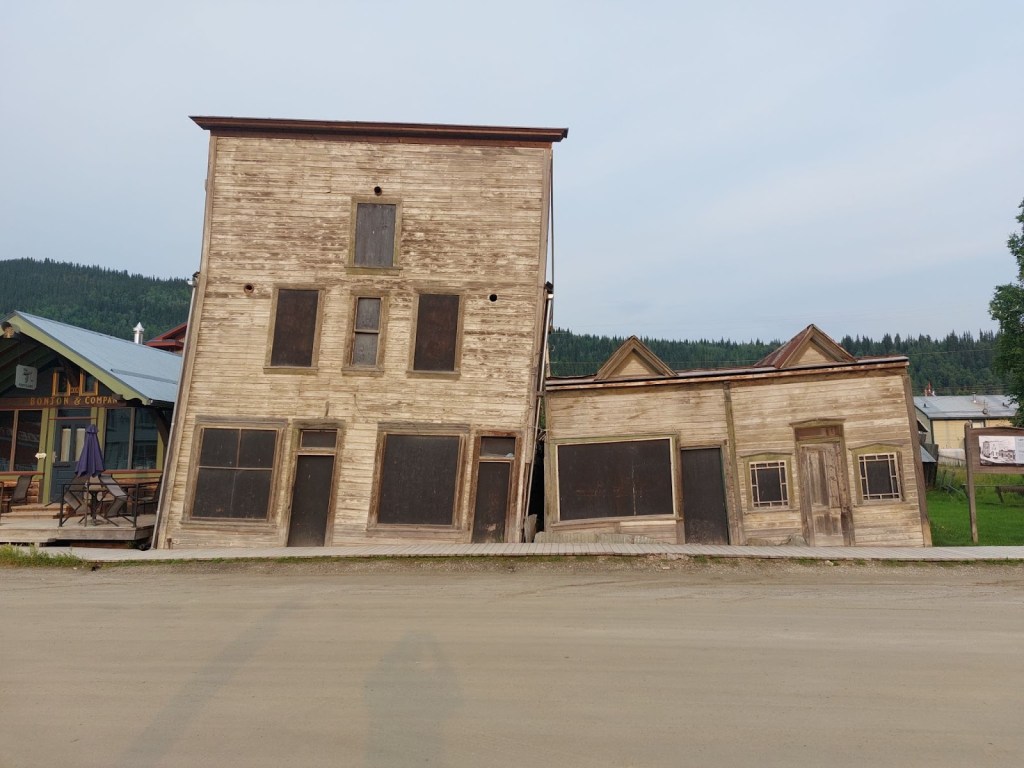
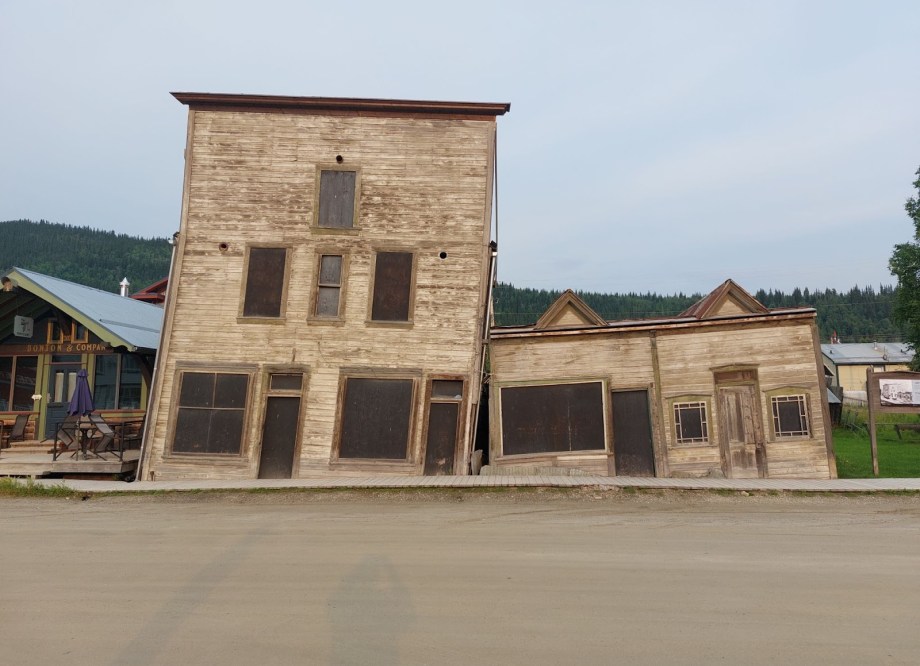
Dawson City at 700km is the easier option. There’s a town, shops, accommodation, and transport services that can get you back to Whitehorse. It’s the official cut-off point for the 1000. Teams that don’t make Dawson by the designated cutoff time are pulled out by the Race Director. Getting home from Dawson will cost you a bus ticket.
And then it gets complicated. Over the next 900km, there are five more settlements, Eagle (840km), Circle (1030km), Fort Yukon (1140km), Beaver (1260km), and Stevens Village (1375km). Eagle and Circle are accessible by road, but in both cases, long rough roads that go nowhere else. Fort Yukon is only accessible by air. Beaver and Stevens are villages supplied by riverboat.
If you can paddle yourself to one of those settlements, you’ll need to concoct a plan to get yourself to a major town using your wits, the $200 cash we were required to carry, and a credit card, also mandatory equipment. Retrieval of the rented boat would be another thing altogether, and you’d have to expect a little grief from Thomas with regard to how his very expensive race boat was sitting on a riverbank in the middle of nowhere and not delivered to him at the finish line as expected.
If you find yourself unable to self-evacuate, you’re entering a whole universe of complicated. The race fees include provision for evacuation of casualties – or corpses3. At the lower end of the scale, you can use the mandatory sat phone to call for medical advice, progressing up-scale to a full boots-on-the-ground Casevac (casualty evacuation). The rescue coordination centre will assess your situation and mobilise whatever assets are required to evacuate your casualty to a suitably equipped hospital. With caveats…
They probably won’t get to you for 48-72 hours.
They will probably ask you to get yourself to a rendezvous point with an airfield that can accommodate a medevac flight.
They won’t take your boat, your gear, or your partner. There will be a space on the plane for the medical team and the casualty. The uninjured member of the team may be expected to paddle to Dalton.
In addition to the evacuation and medical cover carried by the race, each team is required to carry enough insurance to get themselves home, walking or otherwise.
Over the 12 hours we were parked on a sandy island upstream from Minto, watching other teams paddle past, we started to assess our options.
- self evacuate via the road access at Minto;
- continue 400km onward to Dawson City for an easy exit; or
- continue past Dawson, if we made the cut off and were feeling OK.
Looking back now, the order of those options betrayed where my thinking had already landed.
What was actually said over the next two days will never be repeated. Kate wanted to continue. Freaked out by the breathing difficulties after a bit of light smoke I wanted out. An argument in the boat is a terrible thing when you’re married.
A phrase I learned from a sea kayaking friend many years ago is “Maybe a casualty, but never a victim”. It means not knowingly putting yourself in situations where injury is likely, even though you might willingly go into situations where it is possible.
By the time we’d reached Dawson, we’d resolved to withdraw rather than continue onward risking an expensive evacuation from the more remote sections of the river. Continuing past Dawson knowing that exposure to more smoke could trigger a serious problem with my breathing, knowing there was the possibility of more fires4 downriver, and knowing we had no medication, would have been an indefensible decision. That bad decision could have foreseeable consequences for our insurance and also for the coverage of the event.
Despite having spent close to 8 hours on the sandy island, we arrived in Dawson several hours inside the cutoff. Jon gave us the option to continue, but accepted our decision to withdraw. He even went so far as to give us automatic entry into the 2024 event if we wanted it.
Agree your red zones for risk before you start the race: Spend time before the race war gaming your responses to possible scenarios. Agree on what constitutes “unacceptable risk” as a team. This is when you withdraw. Do it before the race when you’re clear headed and unemotional. You won’t be that way during the race. In the 2019 Texas Water Safari our 4-person canoe team agreed before we entered that the boat was going to the finish. Everybody understood what that meant for a team member who didn’t want to go on. No grudges, no recriminations.
We were leaving the race as a positive example for next year’s safety briefing, rather than as the team responsible for the new rule.
The next few days were an adventure of a different sort.
Despite Jon’s oft-repeated mantra “don’t make your problem my problem”, he had gone to some lengths to see us right in Dawson. We were given directions to accommodation, and instructions on where to drop the boat. He’d even found two seats for us in a vehicle going through to Fairbanks where we could rejoin our FedEx’ed gear and resume our travel plans back to Sydney.
We spent a night in Dawson, which included a stop at the General Store for emergency clothes. I was talked out of buying the cheapest t-shirt in the shop, a Barbie-pink shirt with “3rd Drunken Bitch” emblazoned across the chest. Likely surplus from a canceled hens night. We ended up buying dinner for Thomas to make up for the damage we’d done to his boat on day one when we‘d been cutting corners to save time. When we’d first spotted him, we’d ducked down an alley to avoid his wrath, but you can’t dodge consequences for long in a town the size of Dawson. He was remarkably chilled about the damage after a few free beers and assurances we were going to pay for the repairs.
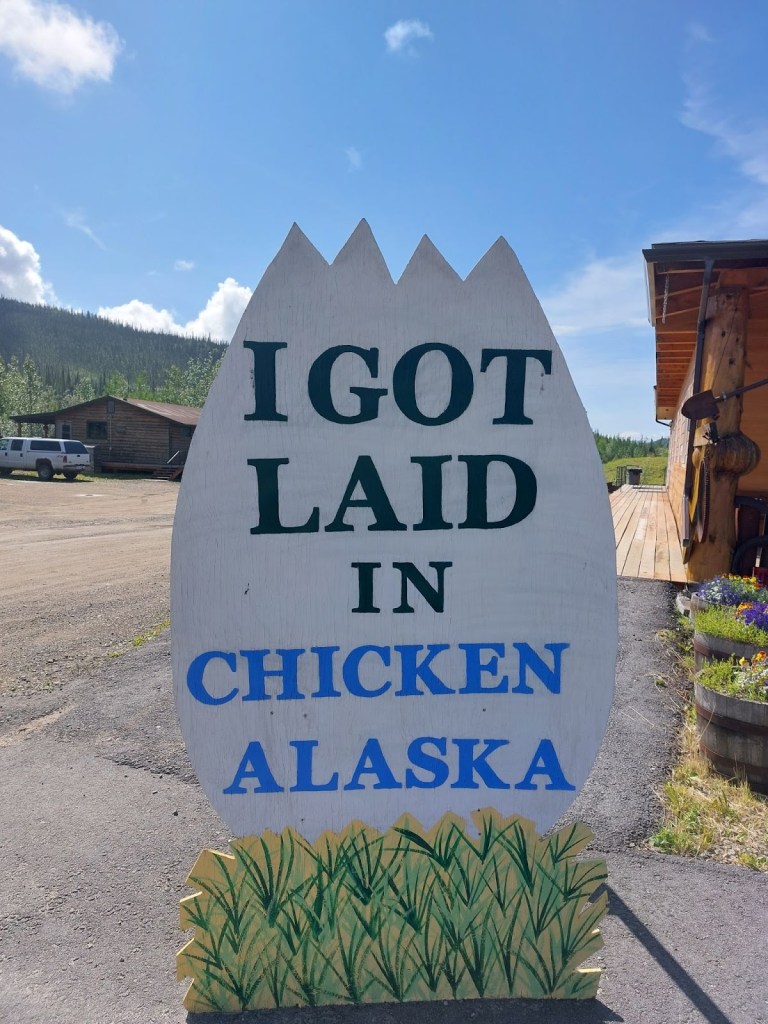
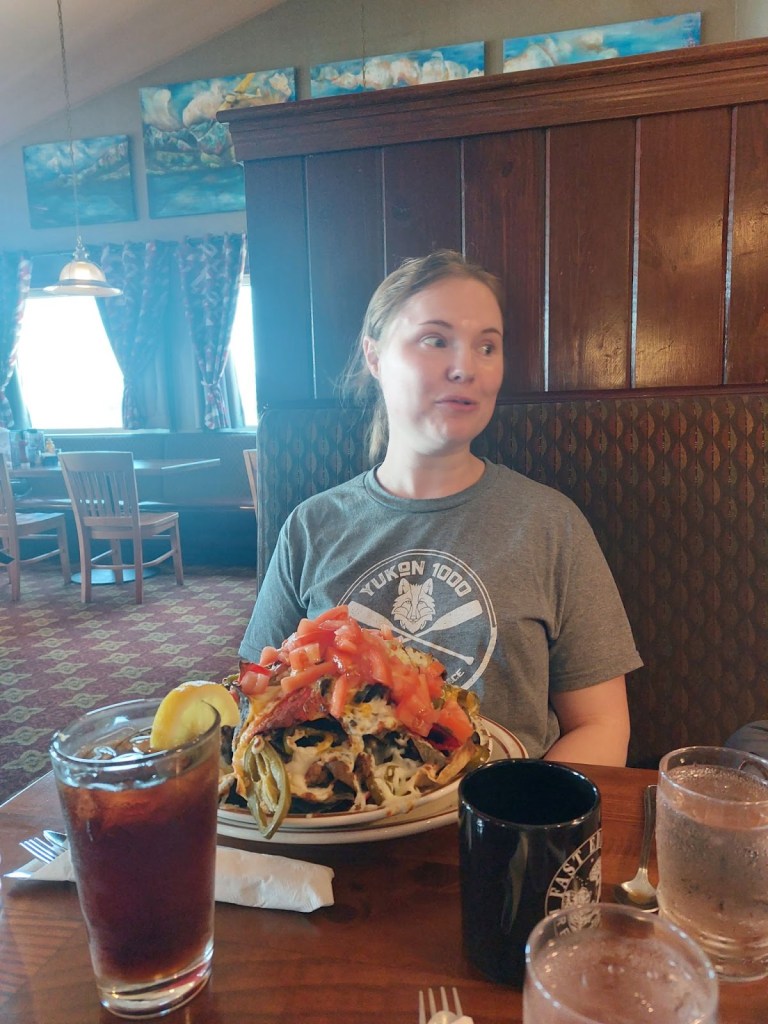
From Dawson, we traveled with Chloe and James, the film crew following the race, to Fairbanks Alaska via the Top of The World Highway. We crossed the US Border at Poker Creek, where the border agents just smiled as we tried to scan our fingerprints with blistered hands. We passed through a bucket list of places which would otherwise be too small on the map to be noteworthy – Chicken, Tok (where Chloe bought a single serve bowl of nachos that obscured the sun), and the Santa themed North Pole. We bought t-shirts at each of them which are possibly as rare in Australia as the Yukon 1000 shirt we’d failed to collect.
We agreed to an interview with Chloe and James in Fairbanks and talked about our race, the withdrawal and how we came to the decision. Inevitably it would wind up on the cutting room floor, not suitable fare for the Yukon 1000 promo they were sent to shoot. For us though, it was a chance to clear the air, close off the history, and turn to the future.
By the time we left Fairbanks, we had a plan for 2024.
Non sumet nullus pro responso5
Help encourage more posts by buying Steve a coffee…
Choose a small medium or large coffee (Stripe takes 10% and 1% goes to carbon reduction)
Or enter a custom amount
Your contribution is appreciated.
Donate- During the gear check, Jon observed that many of the teams were packing smoke masks which satisfied the requirement, but which were probably poorly suited to the task. ↩︎
- Thomas from Yukon Wide is a Yukon institution. It’s something you have to experience for yourself. We get on great with Thomas. Even though we also bought our own boat for 2024, we still dropped in to see Thomas, just to say hi and get the full Yukon experience. ↩︎
- Nobody has ever died doing the Yukon 1000. But don’t be surprised if it comes up in the safety briefing. ↩︎
- There were no more fires and no more smoke in 2023. The smoke we experienced was blowing in from fires 20km NE of the river.
↩︎ - Translation: She won’t take no for an answer ↩︎
 Rivers of Dust and Ash
One thought on “Prologue – Non sumet nullus pro responso”