Whitehorse – Laberge – 20 km short of the Big Salmon
| Start Time1: | 10/07/2025 07:25:00 |
| Start Location: | 60°43’1.4160″N 135°2’48.8040″W (Whitehorse, YT) |
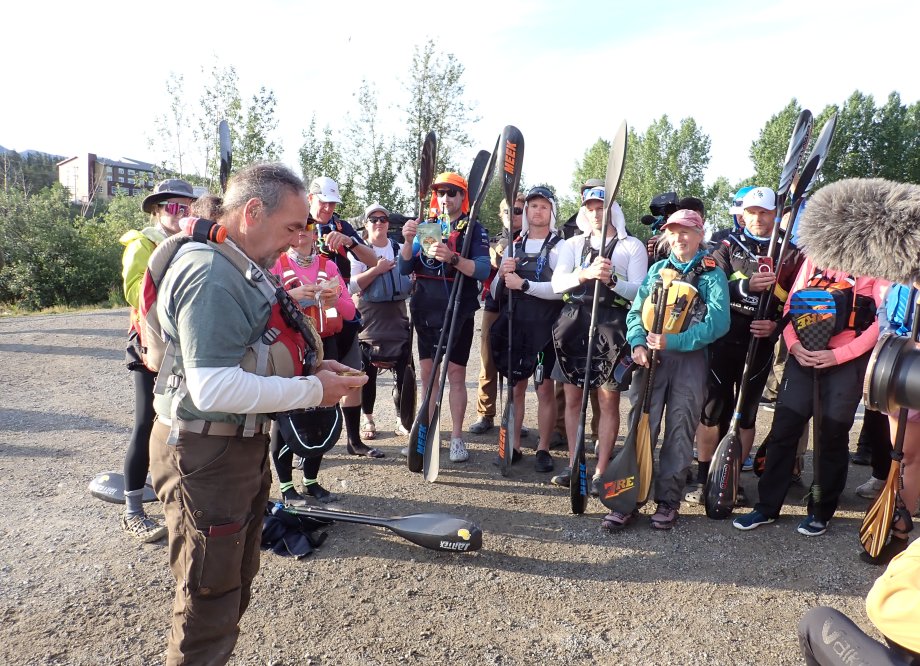
Race Director Jon Frith lined the teams up across the parking area for his final words and the traditional blessing from Glenn Nolan.
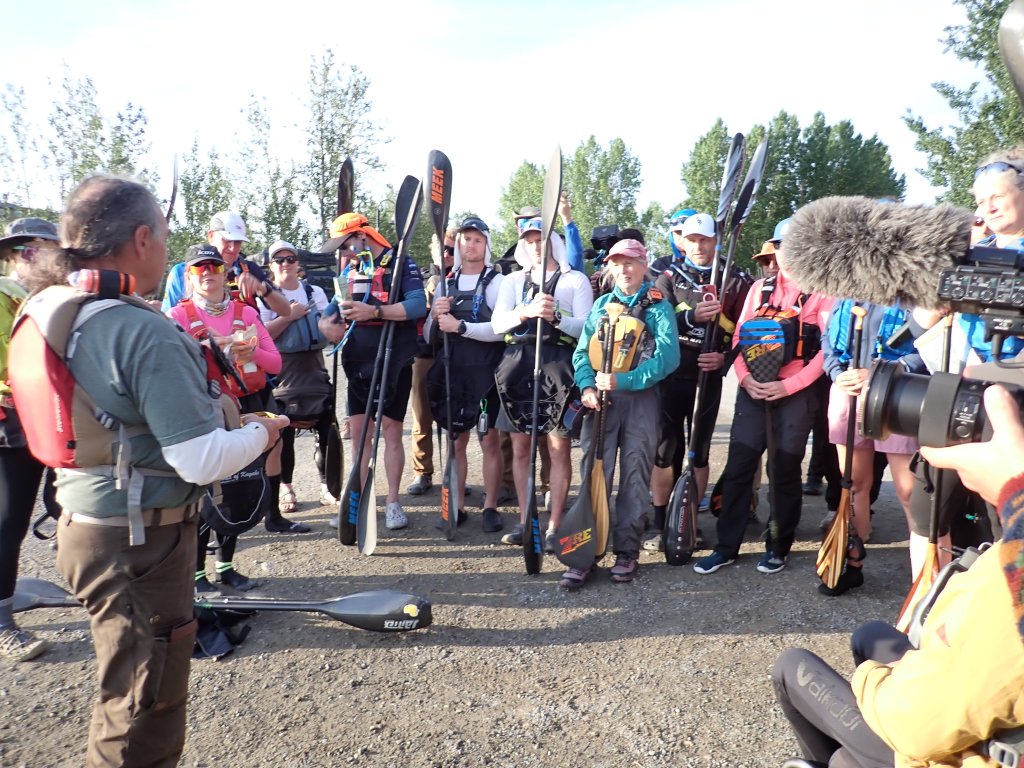
As the clock ticked towards 7:25, Jon’s voice rose “three, two, one, go!”. Our first surprise of the day considering the official start time was 7:30.
We’d arrived at the start almost two hours earlier to prep and pack the boat. Our gear, transferred from two duffel bags, was either packed into the hatches, stowed around the cockpits, or lashed to the deck. We like to keep the decks relatively clear or at least well organised. Forward on the bow, with a painter line clipped and tucked under, there’s a spare paddle in a sleeve. We have a low profile deckbag in front of each cockpit for maps, sun screen, gloves and hats which we’d want to access quickly and often. Pills – ibuprofen and Voltaren – were in there as well. A film canister for the day containing the maximum recommended dose for 24 hours. Later in the race, we’d lose track of where we were on the 4 or 6 hour cycle of meds and being pre-allocated kept us mostly in check.
Behind each cockpit, we have water bottles mounted in cycling cages, a luxury we can afford because we owned the boat in 2024 and didn’t have to ask permission to drill holes. Food for the day was in a foil ziploc bag on the floor of the cockpit. It had initially included daily meds. Each day, we’d pull a ration pack from the back hatch, secrete pills and a few other goodies and start the daily fuel cycle anew.
Behind Kate in the back cockpit, a manual bilge pump, and finally our foam sleeping mats which are too bulky to stow. Foam mats are controversial with some, who prefer the comfort of a thick inflatable mat. Our view is that the foam mats don’t need to be inflated, you shake them off and they’re dry enough to sleep on, and they are an absolutely effective thermal barrier on cold ground. Most importantly, they don’t puncture. Sure they don’t provide much comfort, but if you’re tired enough, you honestly don’t care. We’ve learned to side sleep and curl around errant rocks that we hadn’t seen while pitching our tent.
A blister kit with tape, bandaids and antiseptic wipes was packed behind my seat along with rain gear and reserve thermals in a loose drybag. The blister kit was a planned improvement on the previous year, separating the things I expected to use every day from the other items in the first aid kit. The drybag for rain gear was a bit pointless, since it would be a wet bag as soon as we swapped gear for the first time, but it would serve to separate items we would be wearing from whatever would be sloshing around in the cockpit over the next week.
Improvement: A small accessible blister kit in a dry bag. We separated it from the main first aid kit, which we could then leave stowed safely in the dry compartment. The blister kit I was accessing every day.
The two storage compartments in the boat were packed strategically. The front compartment contained items we’d not need until we were past Dawson, 3 or 4 days from now, along with clothes for the end and other kit we’d prefer not to call on. Food packs for the next three days, tent, sleeping bags, satphone and bear spray were all stowed together in the rear. We’d hopefully only open one hatch when we camped for the night and pack it back the next morning.
Finally, the two duffel bags got rolled up and stowed in front of the foot rests. We wouldn’t need them again until we emptied the boat at Dalton Bridge.
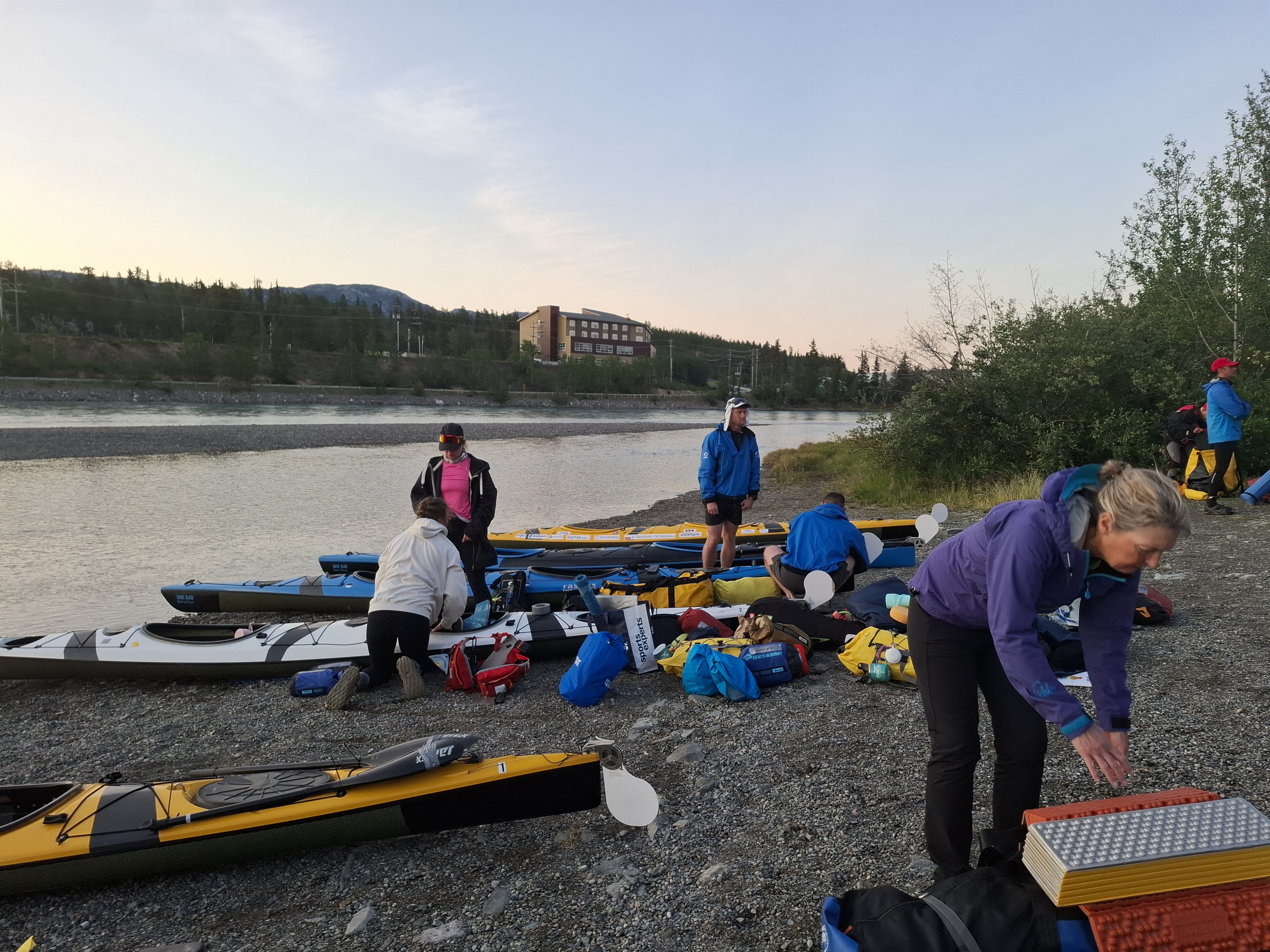
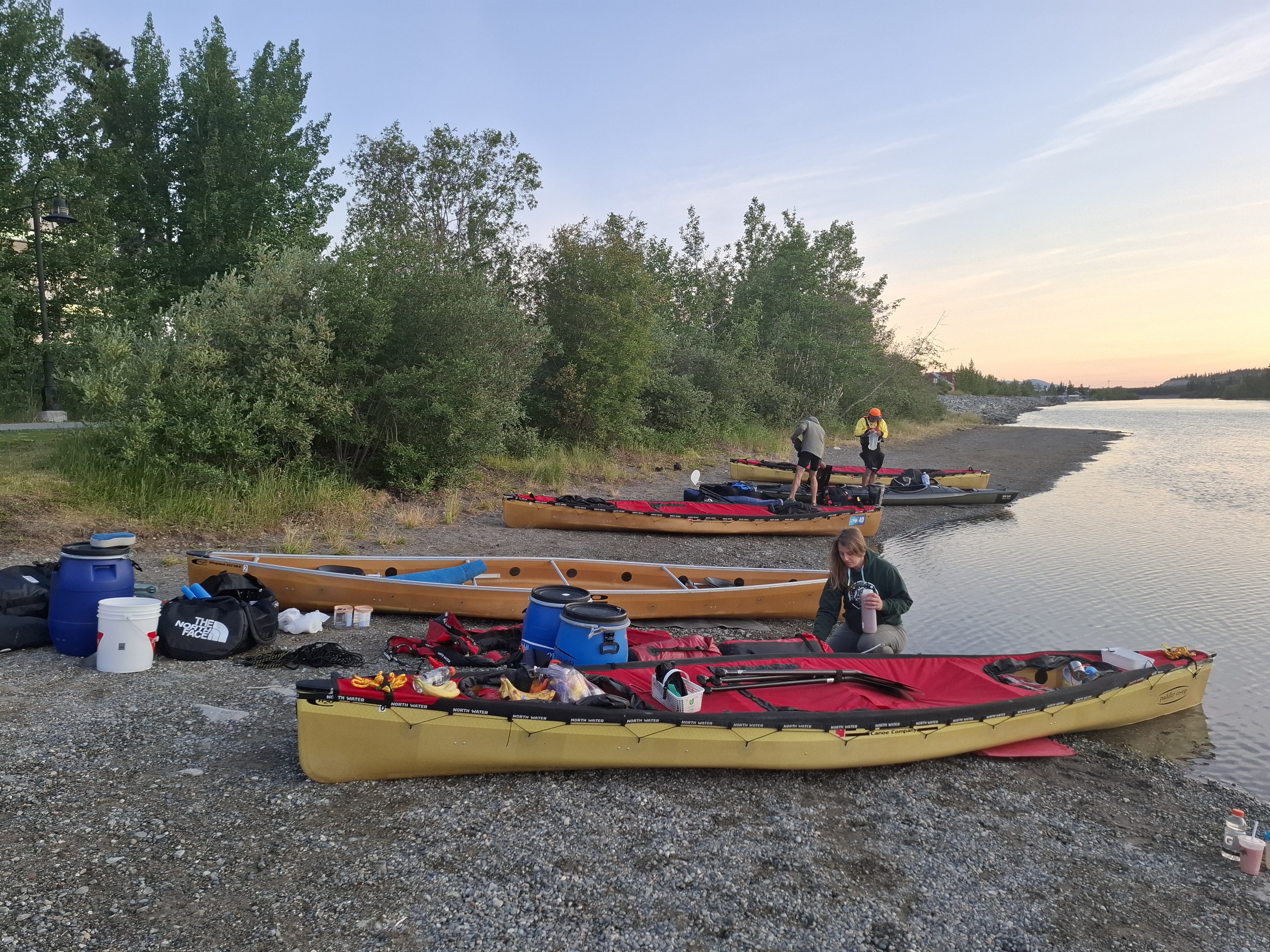
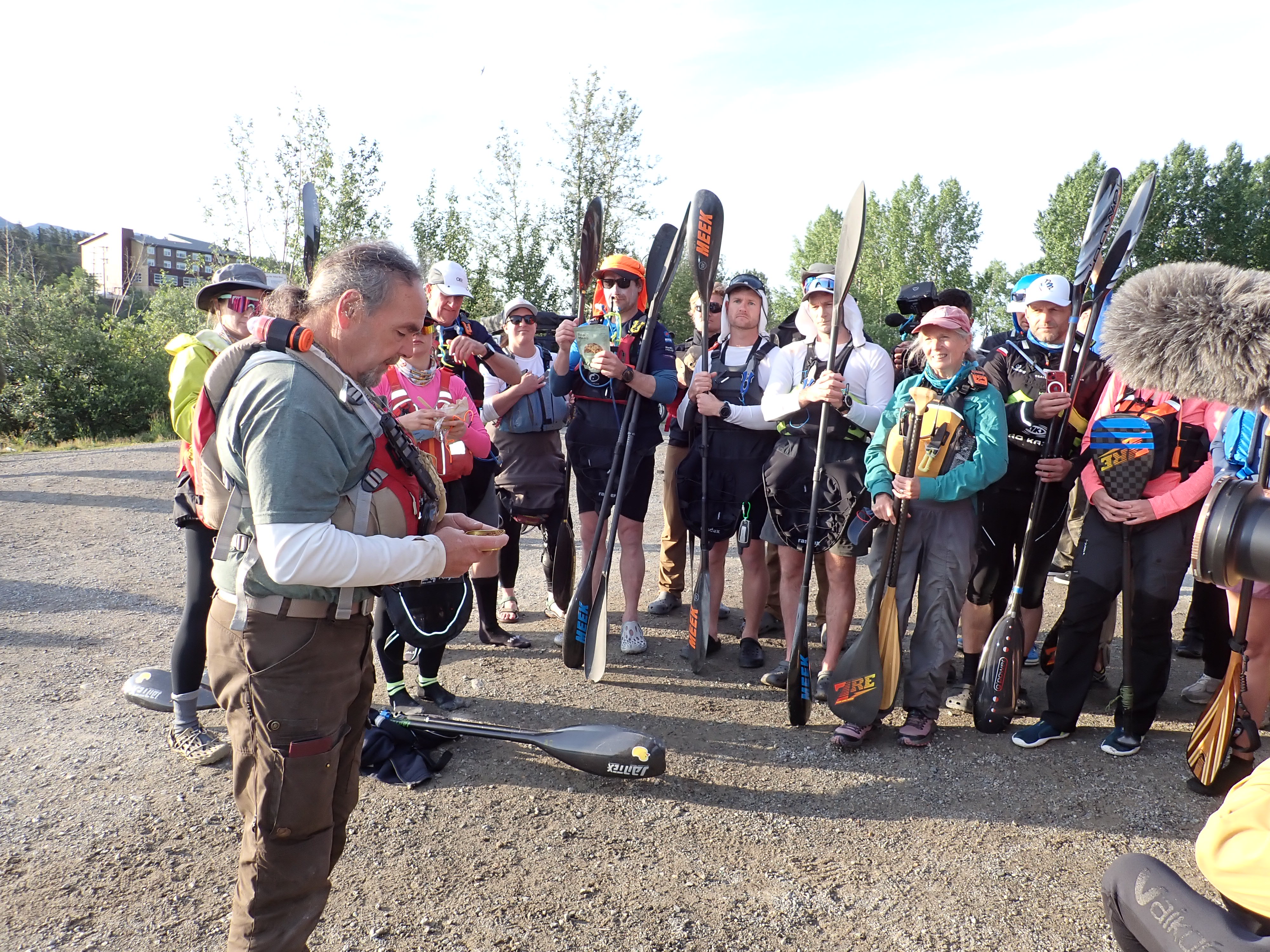

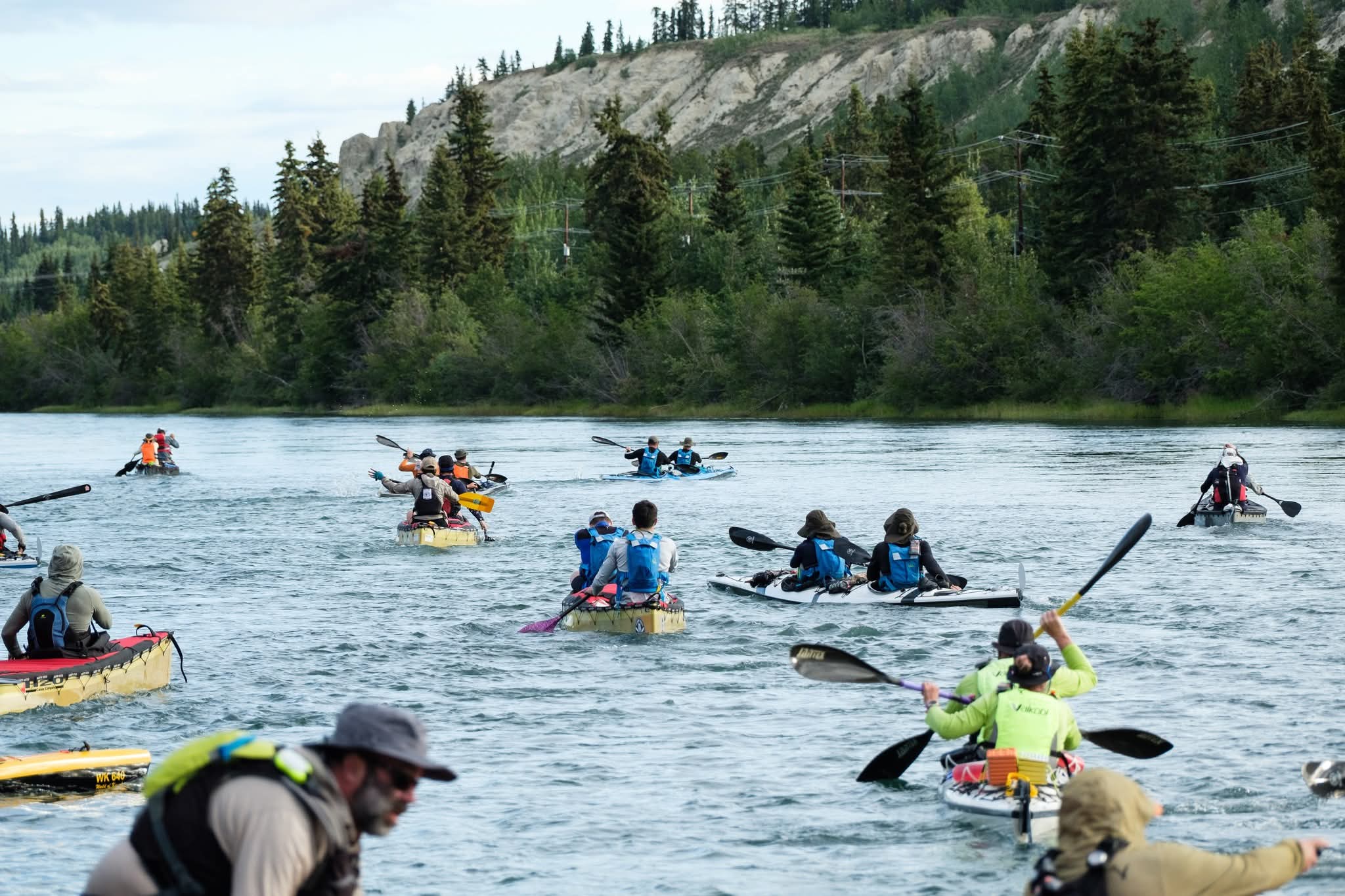
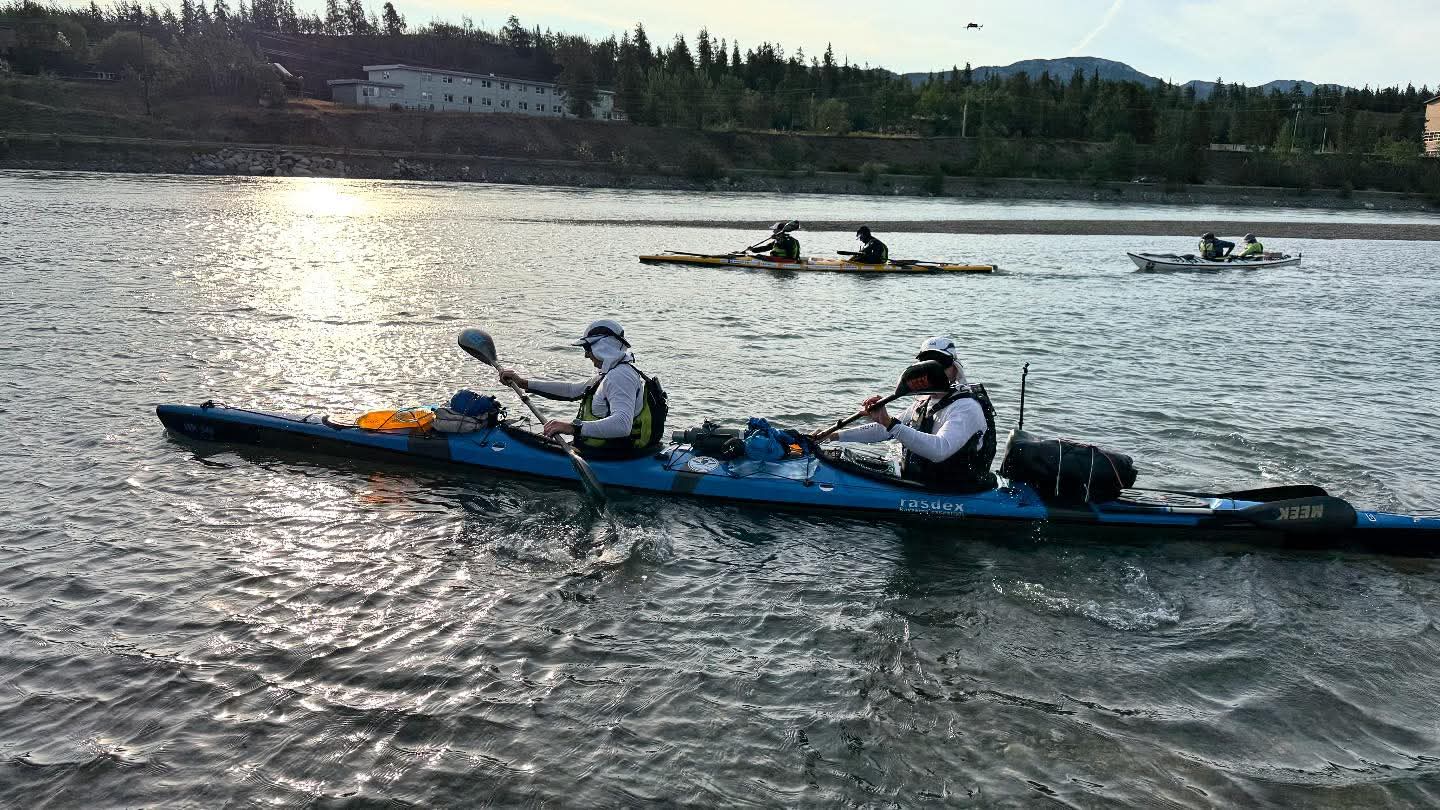
Fully loaded the boat had gained 60 kg. Accordingly we’d positioned it on the beach with the bow in the water to avoid some damage from dragging the hull over gravel with all the additional weight.
The teams had arrayed themselves along the beach with some choosing prime spots on the downstream extreme. It gave them some sort of minor advantage in the Le Mans start. We’d drawn the second most upstream spot as a result of being the last boat off the trailer, but we weren’t too worried, we’d make up the 50 m pretty quickly when we got on the water.
And that would have been true if we hadn’t made a rookie mistake.
We’d left the rudder flipped up and clipped to the back deck, so we had no steering as we pushed off the beach and careened straight across the path of the one boat unlucky enough to have put in upstream of us.
Out of the cockpit, run back, unclip the rudder, and get back into the boat. Thankfully we were still in shallow water.
We were now dead last. The upside being that we had 21 boats in front of up so we had a good starting point to track our placing as we began to claw back the 200 m we’d just given away.
Jon had seen our balls up and sympathetically turned the camera away to avoid shaming us in the social media post from the start.
The drone flying above captured it perfectly.
It’s 35 kilometres from the start line to the entrance to Lake Laberge (or Lake Lab-Er-Jay as West Hansen confidently pronounced it – rhymes with Faberge as in perfume and ornate eggs). The river was lower this year and the satellite images we’d checked pre-race showed that several of the inside cuts we’d used last year were either bone dry or concerningly low this year2.
We’d be sticking to the deep channels on the outside of the bends where the flow was faster. In most races we preference the shorter route even though it’s relatively slower. It’s all about the length of the bend.
Our original plan for the lake had been to blast straight down the guts. Last year, we’d been good little Vegemites3 and taken the approved path along the eastern shore, while others had run a more direct line down the middle. With no current on the lake, the calculus is simple, shorter is faster, so following the shore put us at a disadvantage.
Last year, we’d entered to finish. This year we were intent on improving our time. We’ve done 1000 miles in the Passat and know it cruises comfortably through the worst conditions we expected to see on Laberge. We’d resolved that if Jon wasn’t going to enforce the 300 m rule, we could safely run down the middle with impunity4.
We’ve come to expect little surprises in the safety briefing. Jon continually tweaks elements of the race, adjusting gear requirements and cutoff times as he assimilates new information. This year, the 300 m rule got some of that attention.
There’s a passage in my blog from last year about how paddlers will follow the leader even when the leader is doing something patently wrong. I’ve seen it in races where a fast team has led the chasing pack on a magical mystery tour, 5 km off course because they hadn’t paid attention at the safety briefing and continued beyond the turn-back buoy. That race was won by a middling team who paid attention to the course briefing.
The 300 m rule wasn’t new. It had been part of the briefing in 2024. I don’t remember it from 2023. What was new was a 6 hour penalty for the first two boats who deviated to the middle of the lake, because they would be responsible for pulling other teams out behind them. There was an odd logic to penalising the first two teams, but it escaped mention.
It’s 49 km along the shore. 47.5 on a two bearing direct path. You’d lose 6 hours, shaving 6 minutes.
Hint: The YRQ provided a GPX file that describes the 300m line. Load it onto your GPS and keep it on your left when you’re on the lake.
The teams emerging onto the lake made a beeline to the eastern shore and began the long haul on the currentless lake. Most of the teams were well inside the 300 m line. The one of two that we could see out to our left were close enough that it was probably inexperience judging distance rather than an intent to bend the rules. Judging distance over water is another learned skill that is challenged by the lack of familiar reference points on the Yukon. Unless you have a person or a canoe on the shore, you can never be sure how big the trees are to calibrate your estimate.
We were half way along the lake before the SW wind began to make its presence felt.
I’ve waxed lyrical in the past about our kayak of choice – the Seaward Passat – with its long rudder and excellent handling in rough conditions. It’s not fast compared to the stock World Kayaks 640s, but it is easy to paddle when the wind kicks up.
We were two thirds of the way along the lake when the conditions had built to the extent that the Passat was starting to show its strengths.
To exploit the waves being blown down the lake behind us, we wanted to position the boat so the rise of the wave is lifting the back of the boat so you are perpetually rolling down a lump of water that is moving forward slightly faster than you were able to paddle the boat unassisted.
Wind driven waves have a very distinct form. Unlike long period5 ocean swell where there is often enough wave face for the full length of a boat, wind waves are short period and closely packed. Exploiting a wave
On an ocean swell, you get the boat onto the front face of the wave, far enough up that your bow isn’t stalled by the wave in front. Far enough down that your rudder is engaged in the solid water at the top of the wave.
Too far forward, and your bow stalls in the leading wave and the following wave continues to push your tail forward, causing the boat to skew and corkscrew like a plane in an uncontrolled spin. Too far back, and your rudder uselessly flails in the air behind the wave crest, making it impossible to steer with your rudder.
Hint: Race boat rudders aren’t for turning, they’re primarily for keeping you straight.
The building short period waves on Laberge were the worst of both worlds. Closely packed by the rapidly developing wind conditions, the distance between waves was too short to accommodate a 6.5 m kayak. Boats were either buried up to their hatches in the leading wave, or ass-up on the following waves with their rudders flailing in the air.
Putting a 6.5 m boat into a 6 m hole between waves means you need to accept a little bit of pain from both conditions. To properly engage your rudder, you have to bury just enough bow to let that happen, without triggering a bow-stall. Hard enough to do in uniform waves on open water. So much harder in the conditions that weere now building, and close to shore where the following waves were being crossed by waves rebounding from the nearby cliffs.
Because the waves were quartering from the SW and we were running north, we were constantly running at a an angle to the wave direction, which gave us a little extra length between peaks, but at the expense of permanently riding a right rudder to override the turning force of the following wave behind us.
I think we were about 90% successful.
Judging by the number of boats we caught and passed on the last half of the lake, we were doing better than most.
The traditional raked bow of our Passat is more forgiving than the square bows of the faster WK boats, and the long rudder engages more positively than the low drag WK rudders.
We’ve raced canoes in similar conditions and the C-boats that were holding their own on the lake have my unconditional respect. Kate and I have debated racing C2 in the 1000 but the prospect of a rough day on Laberge is a concern we’ve never managed to overcome.
By now, we’d lost count of our relative position in the race. We could see 5-6 boats forward of us and suspected that there were others who were now well out of sight. The size of the lake makes it hard to see other boats unless you’re quite close. A couple of times what we thought was a leading boat turned out to be a non-racer making their way down the lake.
The mayhem that really disrupted the placings for us began in the final third of the lake. We had no idea or interest in what was going on behind us. In any race, you’re constantly looking forward6.
Rounding a small outcrop, we found West and Paul pulled up on the shore having rendered assistance to a team that had capsized [we’d later find out that it had been the Boomtown Boys from New Zealand]. We’d arrived too late to provide any meaningful assistance, so after checking we were surplus to requirements, we trundled onward.
While the waves were giving us a welcome push along the lake, the nature of short period waves is that they typically aren’t going very fast over ground (This would change later in the day). We were getting some relief from the grind, but we weren’t getting any extra speed7. As the conditions developed and the height of the waves increased, we actually found ourselves trapped in the troughs and unable to move faster than the waves around us.
A little further along we passed the Untapped team who had dragged their boat up in a shallow bay. They appeared to be wringing out their gear after an unscheduled immersive extra-kayakcular activity. A shout and a wave determined they were in no need of assistance, so we kept going.
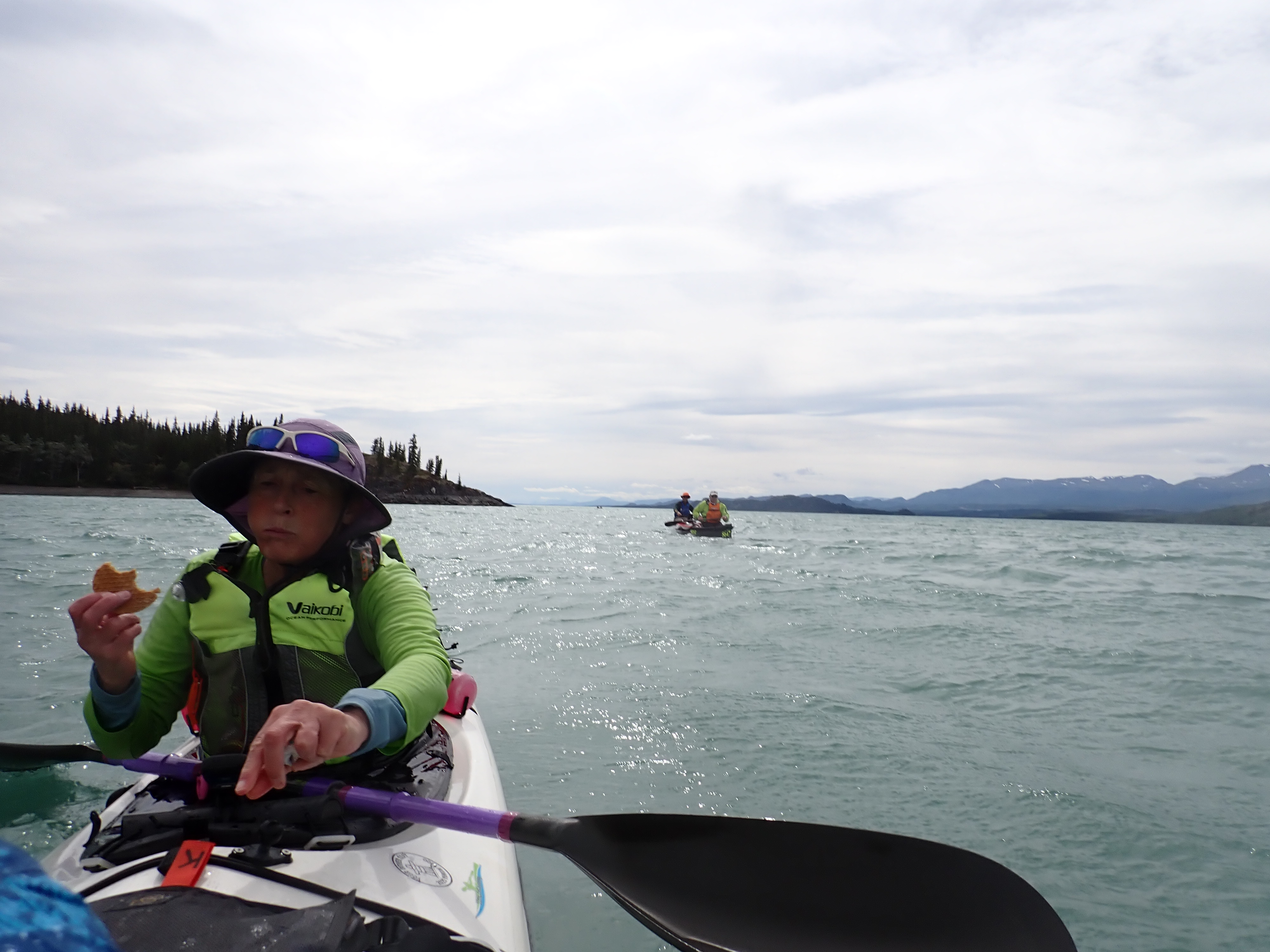
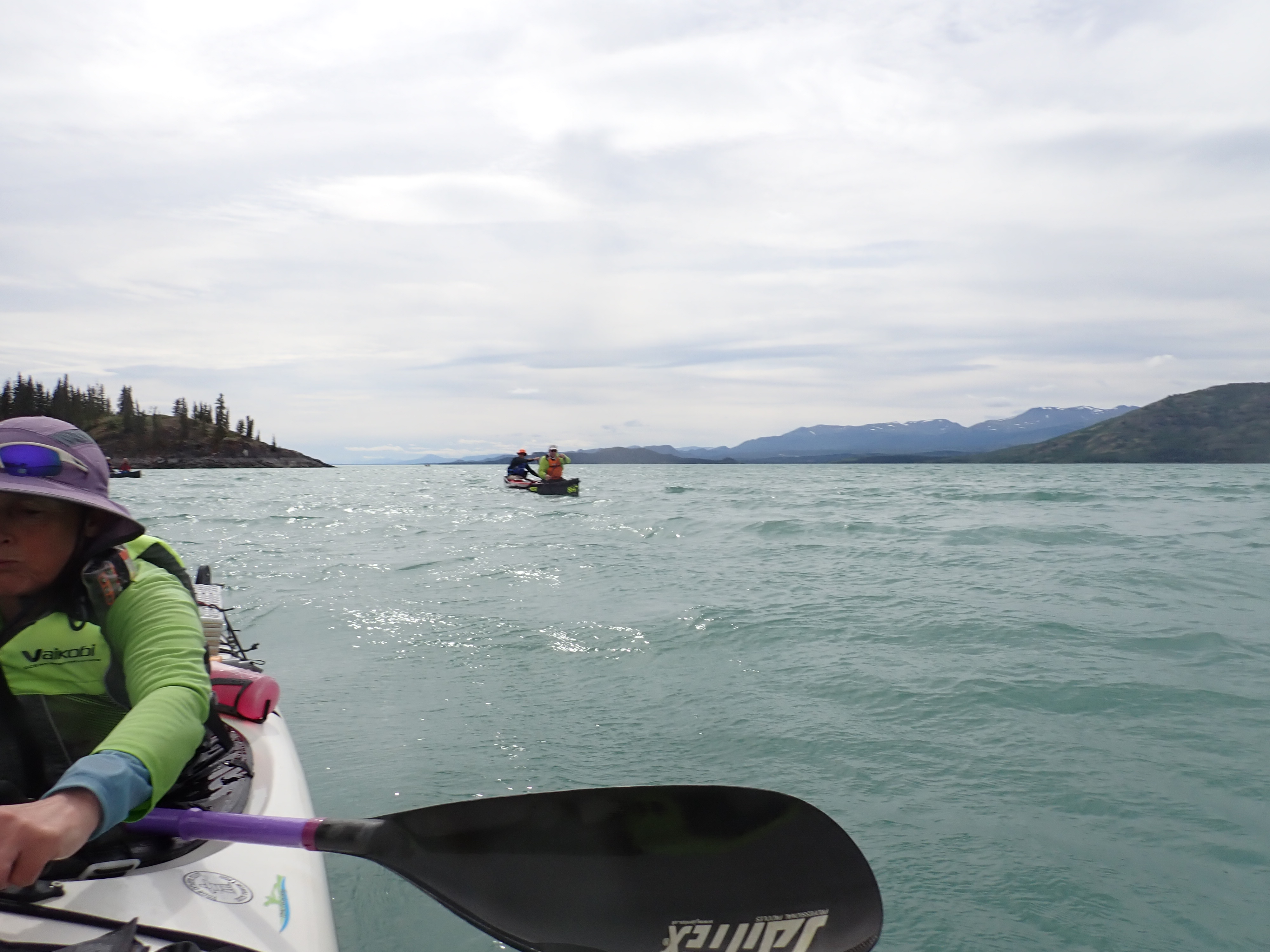
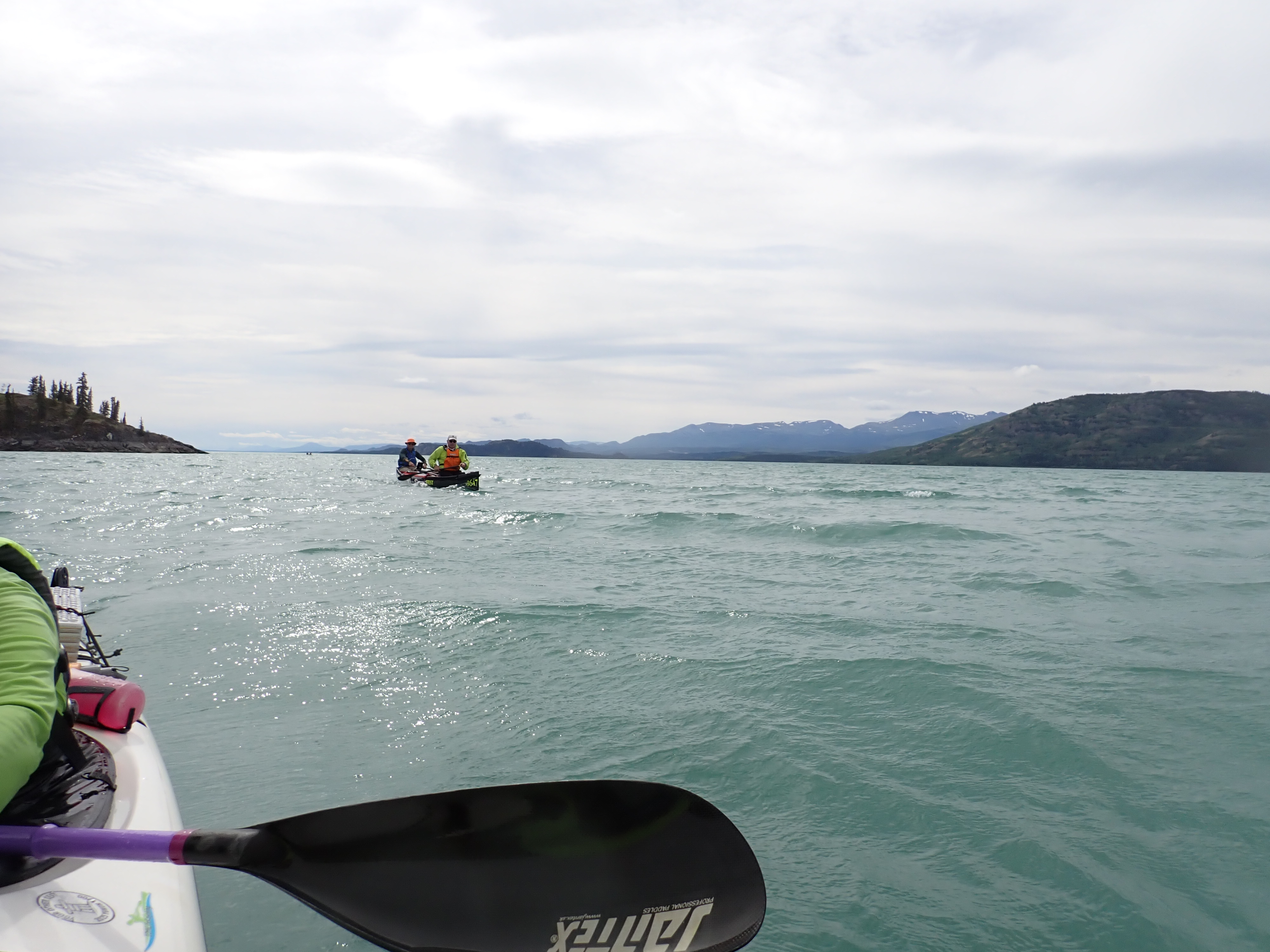
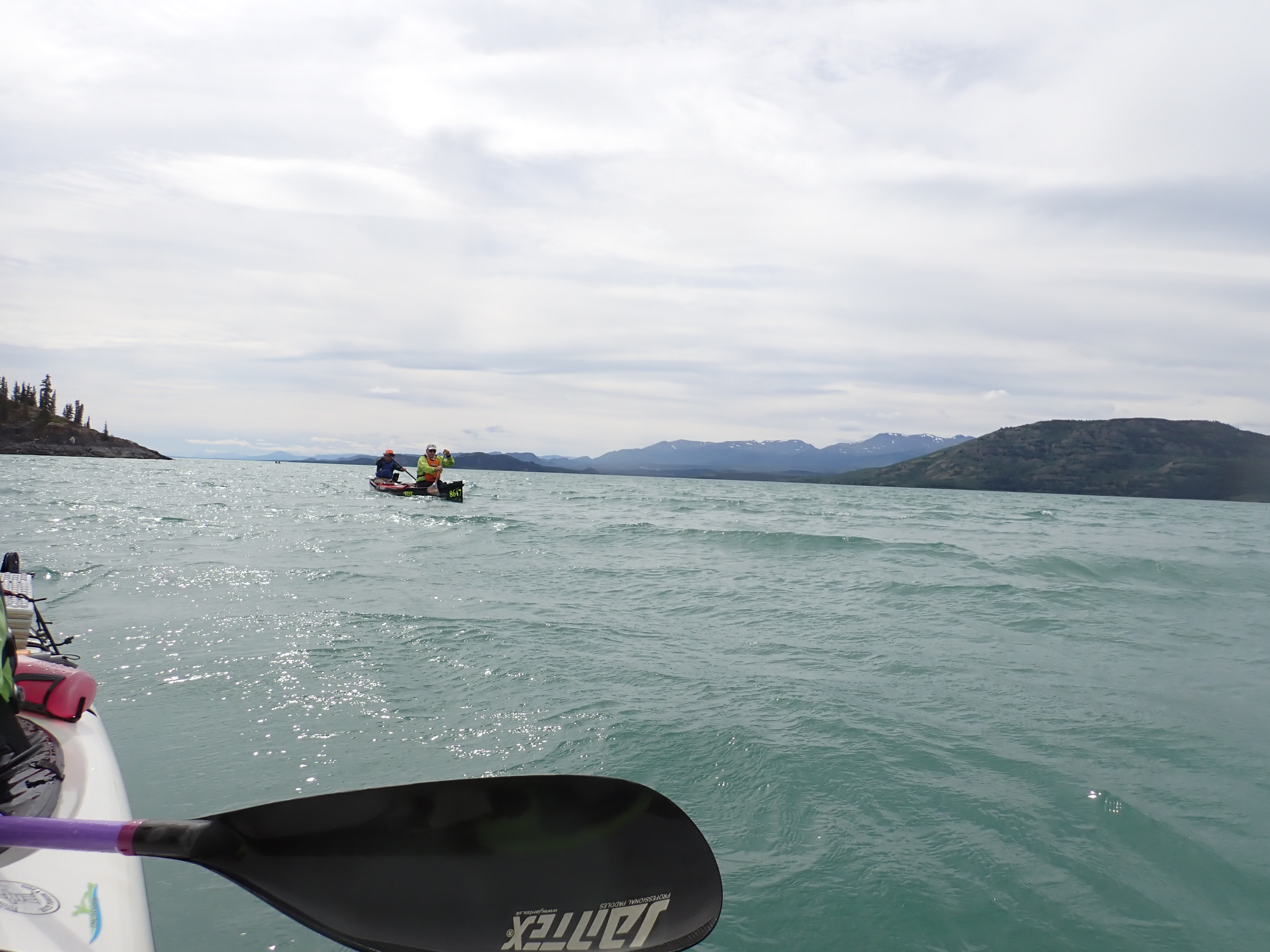
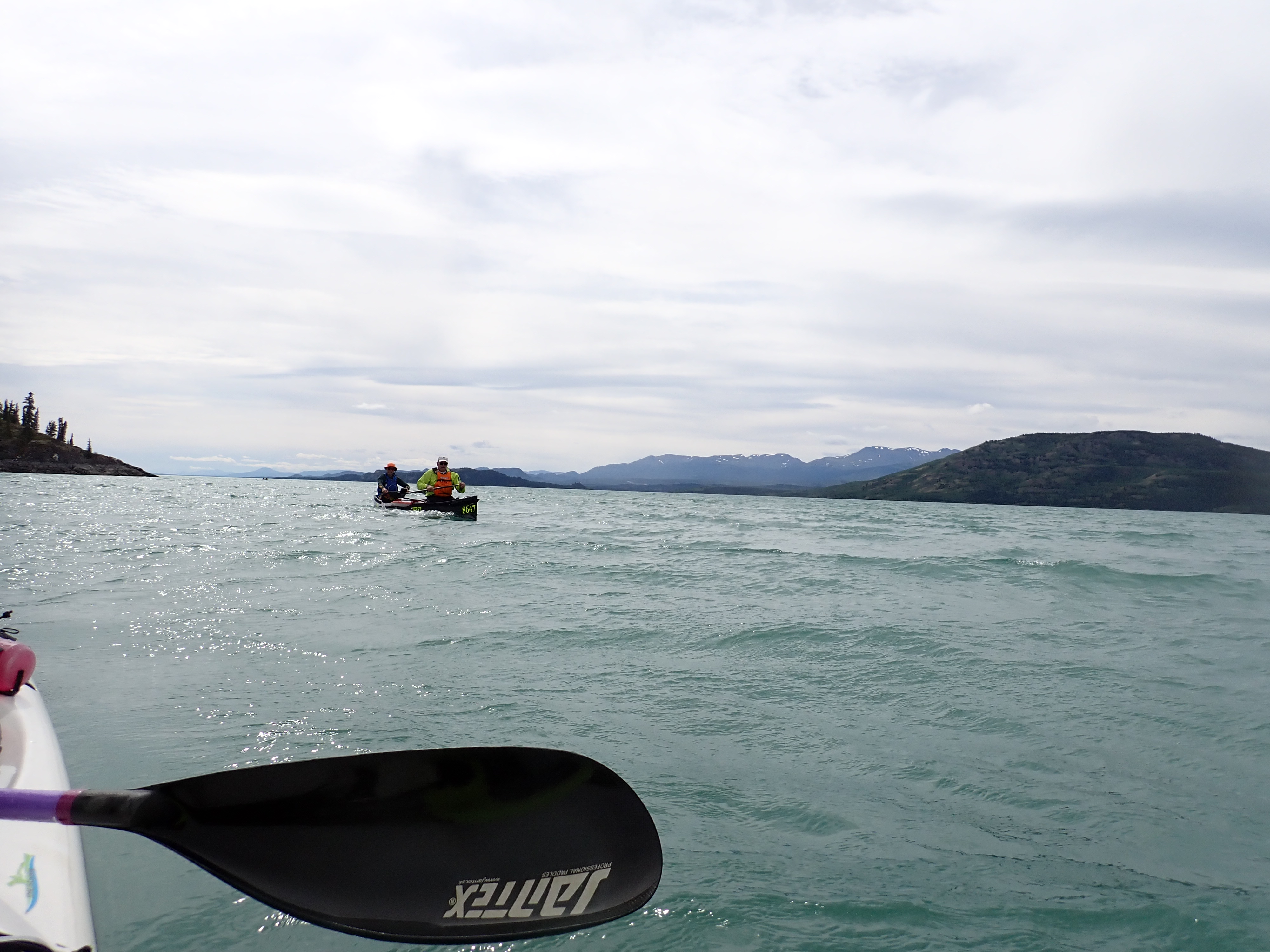
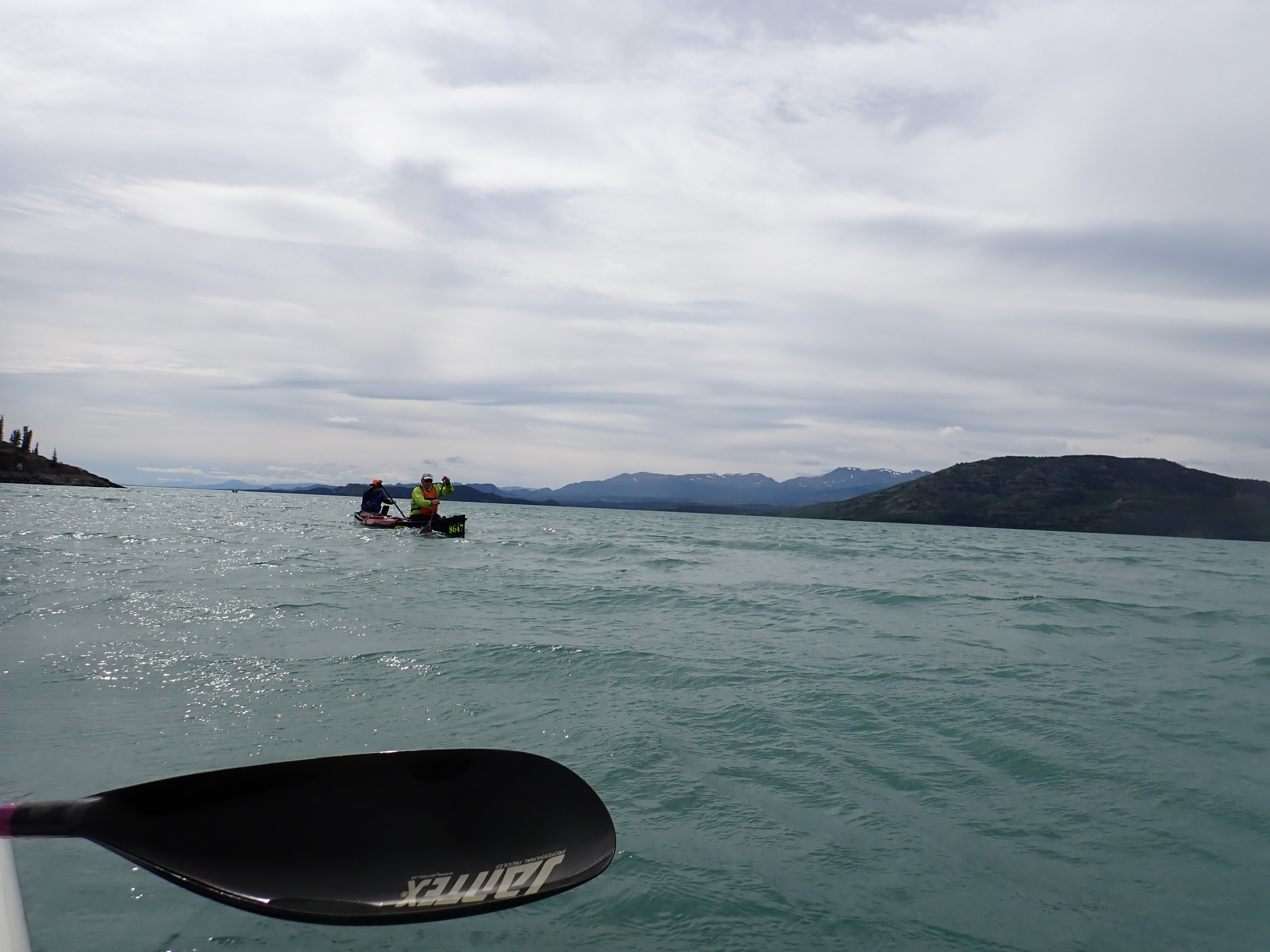
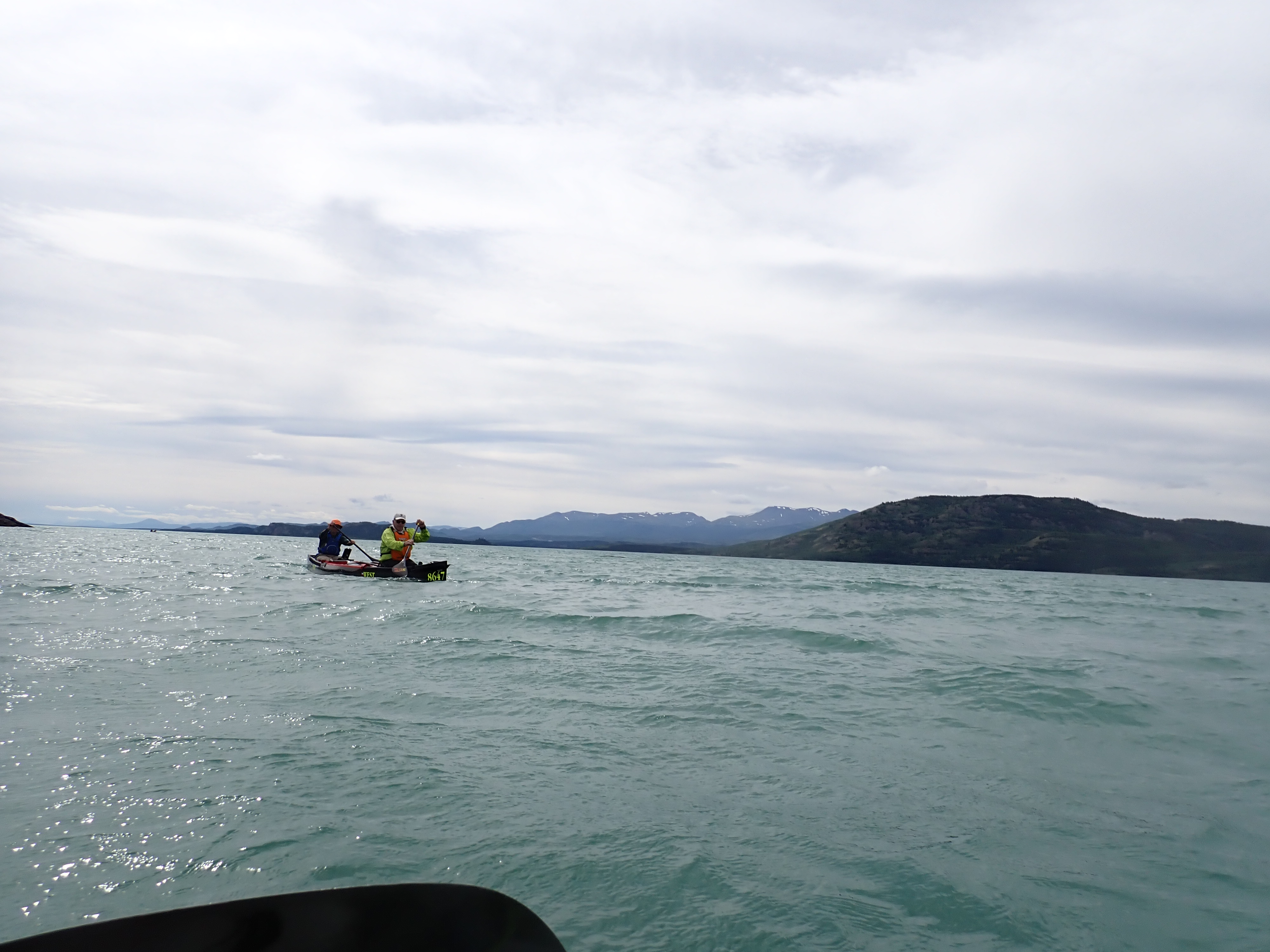
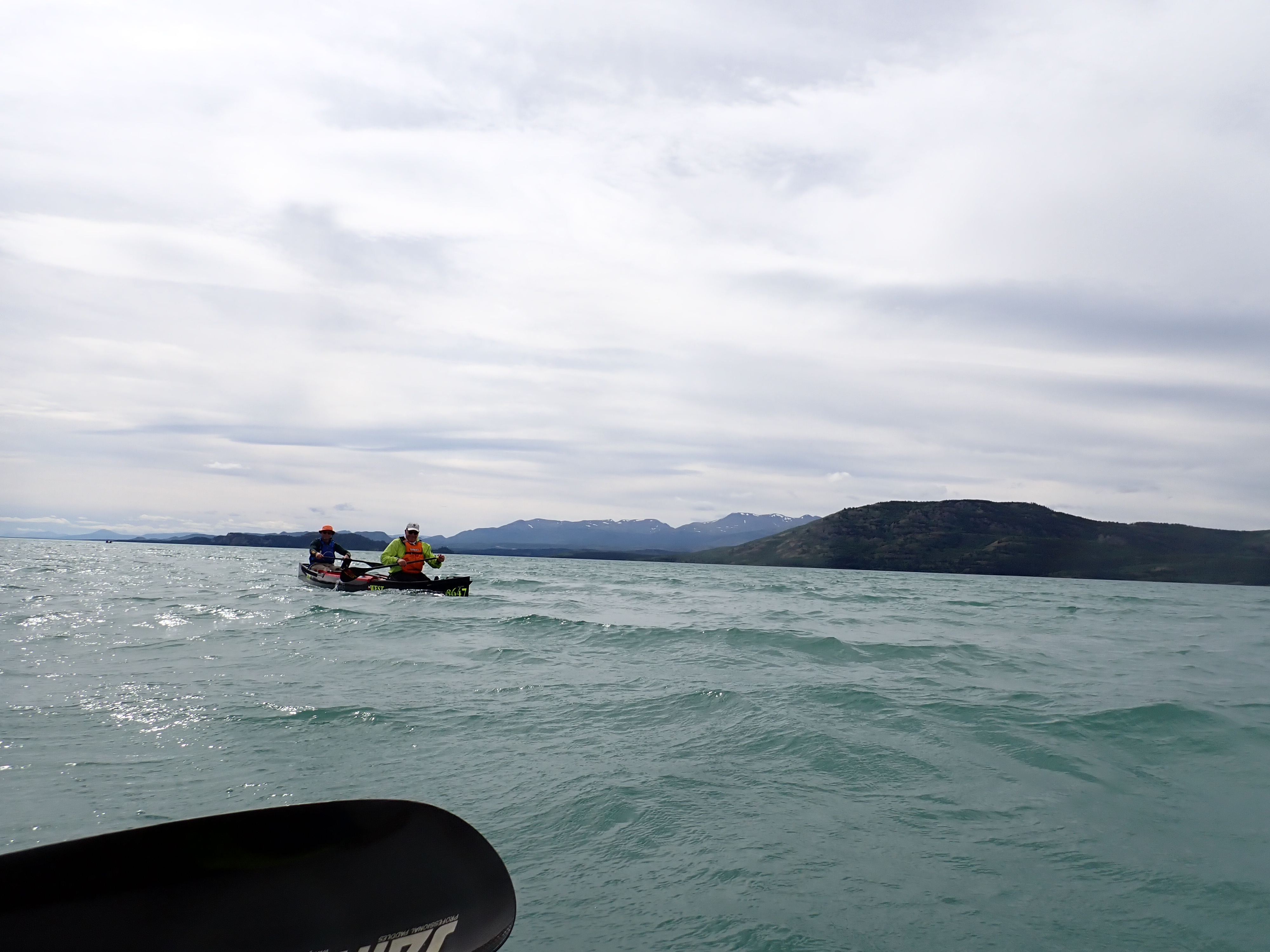

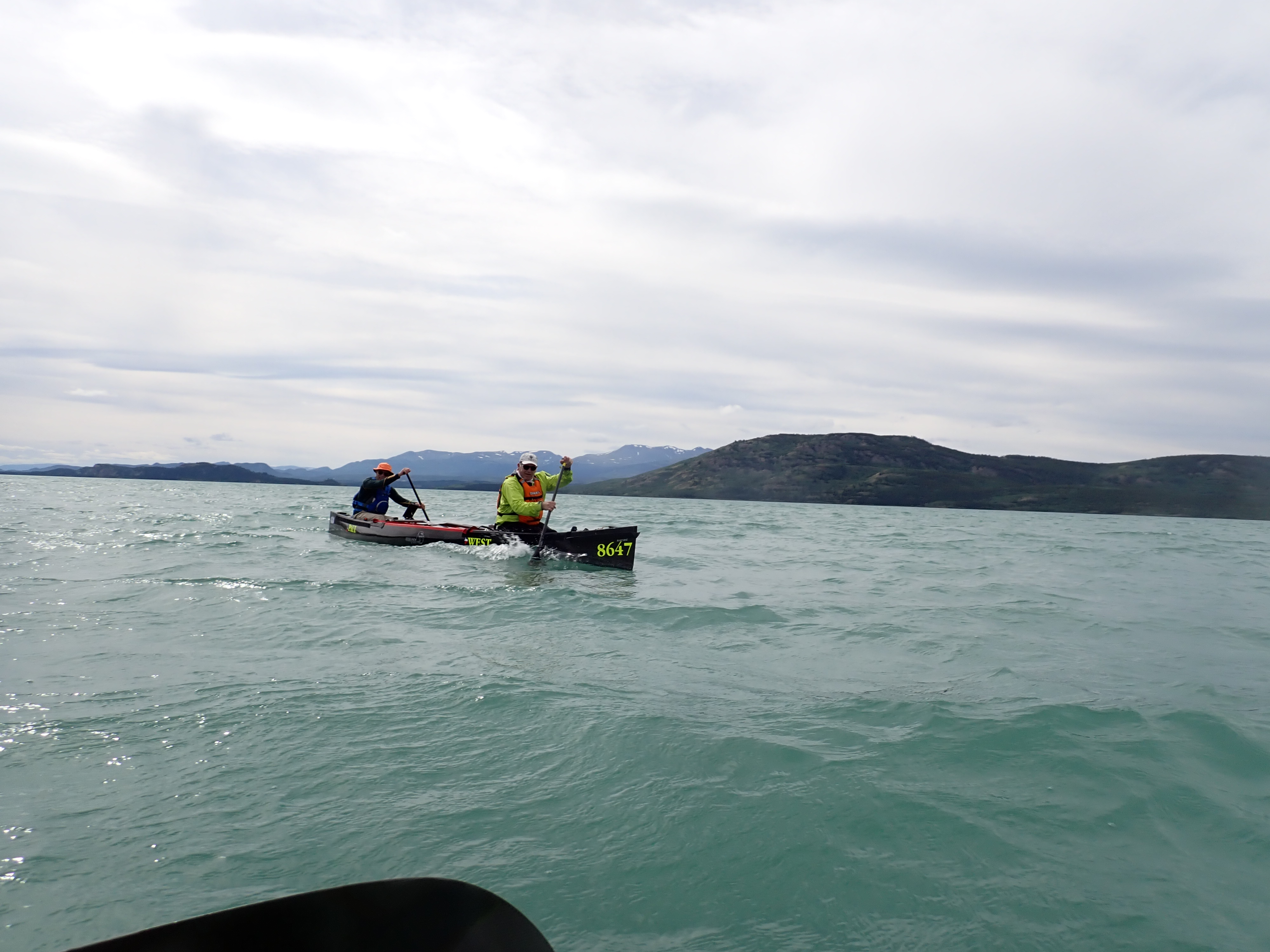
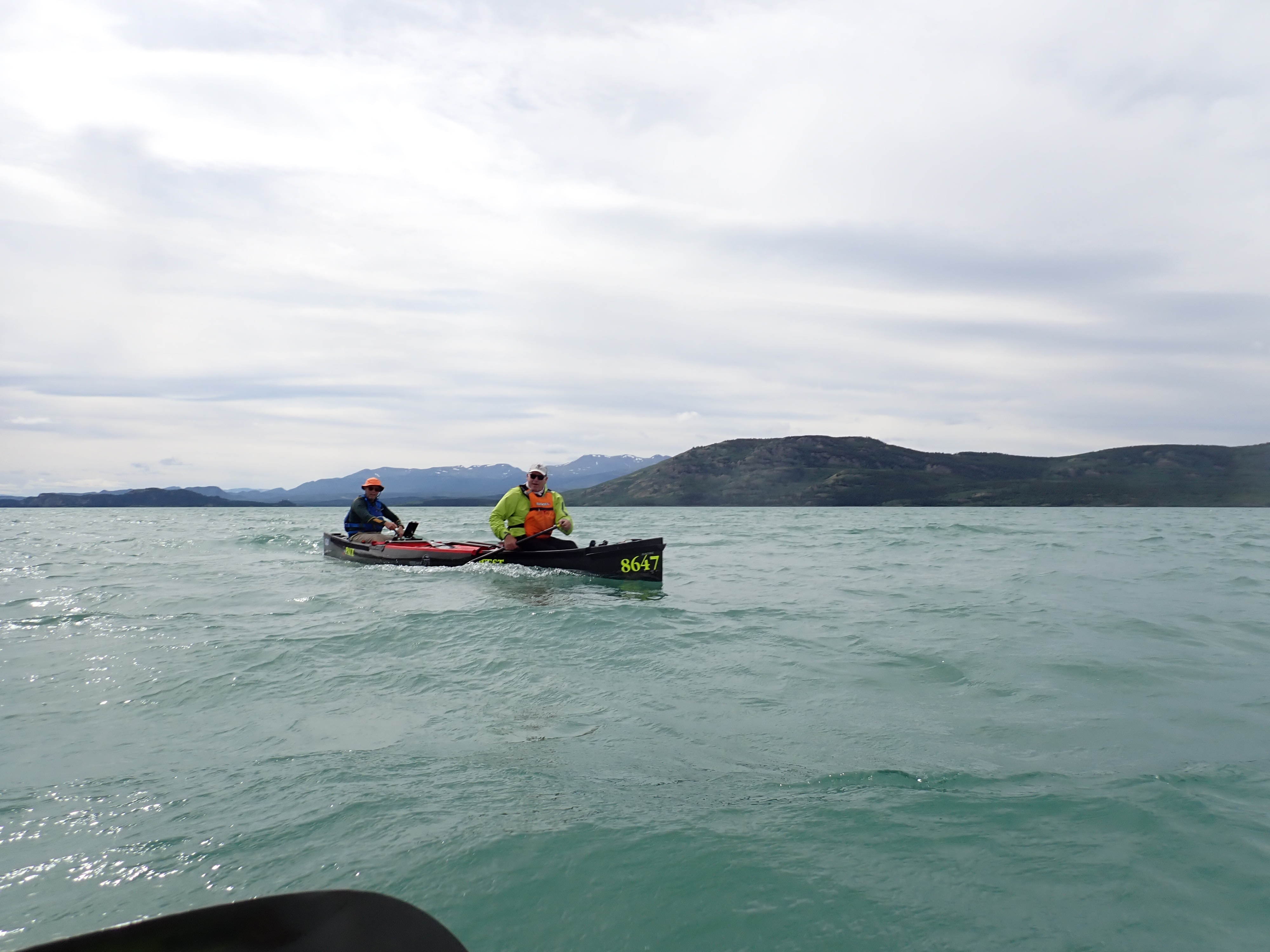
It was on one of our hourly fuel stops that we noticed the canoe of West and Paul were coming up behind us again. They were making good speed, but not obviously enjoying their success. We were alongside for maybe an hour, and several times we saw them catch a wave, surge forward before arcing off as their surging canoe became unstable.
Somewhere in our peripheral vision The Little Duckers from the UK were keeping us in sight, and Mark and Rubio from Spain were also within striking distance. We knew that Mark was a surf kayaker, so he’d be applying his experience in the conditions.
The two young kiwi guys from Get a Dog Up Ya were maybe hundred metres off to our left. They seemed to be comfortable wider out with sufficient room to tack left and right according to the waves they were riding. A couple of times, they tacked inside our line before turning back out.
For most of the lake you’re either well out from the shore on a line between outcrops, or in close to a steep rock wall as you round those same outcrops. There are a few spots where the shoreline is low gravel extending out as shallow you cross shallow lake the water is shallow and those shallows cause the incoming waves to slow and stand up taller. That was a distinctly unpleasant place to be. Even for us.
Conditions continued to build as we approached the end of the lake, a combination of the increased fetch (the distance that the wind is blowing over the water) and the hours that the wind had spent transferring energy to the lake’s surface waves. It was nigh on time to get off the lake.
I’d later find that I’d developed a blood blister on my right big toe from driving the right rudder pedal so hard.
West and Paul had dropped back on us slightly. Maybe the conditions were starting to wear them down? Maybe our pace was picking up a little, now that we were preparing to make the final straight run to the river outlet at Lower Laberge.
The outflow can be hard to pick from overlapping outcrops on the shoreline. We had a GPS track that was pointing us straight at it. We were going to be turning broadside to the incoming waves for a few kilometres but with the exit in sight, we would just suck it up. (it’s 3.5 km – about 25 minutes of sucking it up)
In the last bay before we made our run to the outlet, we saw Mark and Rubio from Spain abruptly turn towards the shore. They beached, climbed out of the boat and seemed to be examining their rudder. When we saw them again (plot spoiler) in Fairbanks, they told us that they’d pulled over to empty out their cockpit after submarining down the lake with the bow buried in waves until it had become unsteerable.
With a small amount of relief – probably smaller than most – we reached the outflow from the lake. We’d delayed our last fuel stop (2-4 minutes every hour for food and fluids) until we were off the lake and back into river where the current would carry us even as we drifted.
West and Paul were a few minutes behind. We were feeling pretty pleased with our position and very impressed with theirs.

West had said pre-race that they were only there to keep the boat in the middle of the river, pointing downstream, not too serious about racing. He’d then posted pictures of a brand new boat, purchased and outfitted specifically for the race, so perhaps they were a little serious.
We were happy enough for them to overtake us at this point. Our plan was to set our own pace and not be goaded into dueling with another team.
As they passed, we compared position counts. We thought there were 4-5 boats in front of us. Paul thought there were three. West was convinced there was only one, describing the boat we thought was a kiwi team we’d seen capsized back on the lake. We’d discover later that we had our Kiwis confused and West was talking about Bob & Gordon from Best Foot Forward who we would never see again.
Either way we were probably in the front third of the field which was a good start particularly as the teams behind us had been shaken and stirred by the lake.
There’s maxim in the 1000 race community that the final positions at Dalton Bridge can be predicted from the positions at the end of the lake. We’d be happy to finish in the front third.
We had an extended feeding pause where we took a few extra minutes to have a stretch and check all of our gear was still buttoned down. We were in pretty good shape. I’d taped my hands with cohesive tape before the start and so far they were showing no sign of developing blisters. In previous years, we’ve found the competitive dash on the lake was the genesis of most of the blisters that would trouble us later in the race.
Improvement: Cohesive bandage tape for blisters and prevention – goes on wet; sticks to itself; doesn’t come off until you unravel it. It provides good protection from abrasion too. At night it comes off easily so your hands can dry out while you sleep.
Kate pulled her rain jacket on. I opted to continue in the rash shirt I’d worn on the lake.
We pushed on downriver in earnest.
It began to rain.
Paul and West were already far enough ahead to be permanently lost from sight. For a long while there was no sign of anybody coming up behind us.
Each night teams are required to stop for six hours rest. Between 10 pm and 11 pm, teams must select a campsite. Once they stop, they must remain in that location for a minimum of six hours. Satellite trackers carried by each paddler are monitored by race control to ensure teams don’t creep during the rest period.
Terrain and campsites permitting, our race plan was to push through to 11 pm each night. Pushing later at night means departing later in the morning. It was a top tip we’d been given by Thomas de Jager a few years earlier. You’ll paddle better if you depart at 5 am than you will at 4 am.
With the rain getting heavier as we paddled into the evening, we were starting to get chilled.
Kuba and Maciek from Poland had closed on us from behind while we were on a fuel stop. (We pause together to fuel rather than one paddling while the other eats. We’ve decided that one paddler pushing a fully laden boat puts too much strain on them, as the natural tendency is to keep up the cadence we had together. It works for us.)
By 10 pm we’d revised our stop target to 10:30 and we were beginning to scan the banks for campsites.
We were both getting cold. In my case it was because I’d chosen not to stop and lose time getting my rain jacket out. We could see the Poles closing on us and we’d been passed by Hi Mom!, one of the mixed canoe teams.
Getting overtaken was probably a sign that the cold was affecting our pace, not just our enthusiasm.
We’d agreed that we’d aim for a campsite beyond 10:30 unless something five star popped up earlier. We weren’t holding out much hope of a campsite that good, until we rounded a few familiar bends which we recognised from the previous year. Up ahead on our right, just as the clock hit 10:30, was our campsite from last year. A broad grassy knoll elevated a few feet above the river at the end of a shallow gravel beach where we could land the boat.
It had been the best campsite we’d found in 2024. Definitely Yukon 5 Star.
It was a bit disappointing to be stopping in the same position as last year. It meant we hadn’t made any additional distance or improved our pace. On the other hand, conditions had been tougher on the lake and we’d had to go further on the river due to low water. We concluded on balance that it was good enough for day one.
Our tent went up quickly. We’re packing a Hilleberg Staika which is a truly freestanding tent. With three poles forming a hexagonal dome, it doesn’t need to be pegged down. We can literally pitch it on any surface.
Tent erected, we shook the rain off our mats, threw them into the tent, followed by sleeping bags and inflatable pillows, which are our only luxury item. Swapping our wet clothes for dry merino base layers, we slid into bed and went to sleep.
Team 5 – Get a dog up ya – from NZ pulled up on the same beach just as we were ducking into our tent, setting up camp on the other side of a shrub, putting them ahead of us on the leader board that night. They were ahead of us by 20 m.
We’d made a last minute improvement to our camp routine this year as we were unpacking the boat on the shore. Rather than filtering water before settling in to sleep we’d decided we could do it in the morning while we were packing up. Part of that decision came from realising that we were packing a hand pumped filter instead of a gravity filter – thanks to Nathan and Sophie for recommending that in their race blog last year – but a bigger part was just being bloody cold and wanting to get warm. Regardless of how we’d come to it, it was good improvement.
Improvement: This year we upgraded from a gravity filter to an MSR pumped filter. The gravity was easy and reliable even with the silt-laden water of the lower Yukon. The manual pump was a lot faster.
Sleeping at night on the race has become easier with time. I remember startling awake from a broken sleep at every sound in 2023, alert for bears. Two years later, I was cold, tired, couldn’t give a rats ass about bears. To this day, I never seen a bear in the wild. I was in a dead sleep for the next 4.5 hours.
| End Time | 10/07/2025 22:34:50 |
| End Location: | 61°45’52.4520″N 134°57’28.1160″W (20 km short of Big Salmon River) |
| Altitude: | 593.0 m |
| Distance: | 165 km |
| Paddling Time: | 15:09:50 |
| Non-moving time: | 00:00:20 (zero time on land) |
| Average Speed: | 11.0 kph |
| Max Speed: | 20 kph |
| Race Position: | 6th |
Help encourage more posts by buying Steve a coffee…
Choose a small medium or large coffee (Stripe takes 10% and 1% goes to carbon reduction)
Or enter a custom amount
Your contribution is appreciated.
Donate- Statistics are taken from SPOT tracker positions, GPS and race tracking. Some times don’t add up due to missing date or time between samples. ↩︎
- Discerning shallow water from satellite imagery is a skill that needs to be developed. All you’ll see from the satellite is a flat surface. Most of the hints come from adjacent vegetation and gravel bars which allow you to build a view of the river cross section. Pick a local feature that you know well and see how it looks from a satellite, then reverse engineer than to guess how an image relates to a remote channel cross section. Then you’ll have an idea whether the span of water is wide and shallow, or hides a deeper channel.
↩︎ - Australian-ism for boy scouts but gender neutral ↩︎
- Running the middle of the lake isn’t just about the shortest path. It’s 47.5km direct vs 49.0km following the YRQ line, so it only gains you a few minutes. It’s more that the mid-line gives you more room to exploit the conditions, particularly if you get the quartering waves from the SW which we’ve had two out of four years on Laberge. Close in to the cliffs, you run out of manoeuvring room very quickly when you’re running down a SW wind wave.
↩︎ - Wave period is the number of seconds between wave peaks as they pass a stationary point. Ocean swell can be 15-20 seconds apart. Wind driven waves can be as close as 2-3 seconds. ↩︎
- It’s worth remembering if you capsize on the lake that only the boats behind you are going to be in a position to render assistance. Another reason to restrict the teams to the 300 m. A capsized boat 1 km out is not going to be assisted or possibly even seen. ↩︎
- There’s a relationship between wave period and wave speed. Speed ≈ 1.5 * Period (where speed is in knots and period is in seconds) at 3-5 seconds, these waves were only doing ~9kph ↩︎
 Rivers of Dust and Ash
2 thoughts on “2025 Yukon 1000 – Day 1 – Thursday”