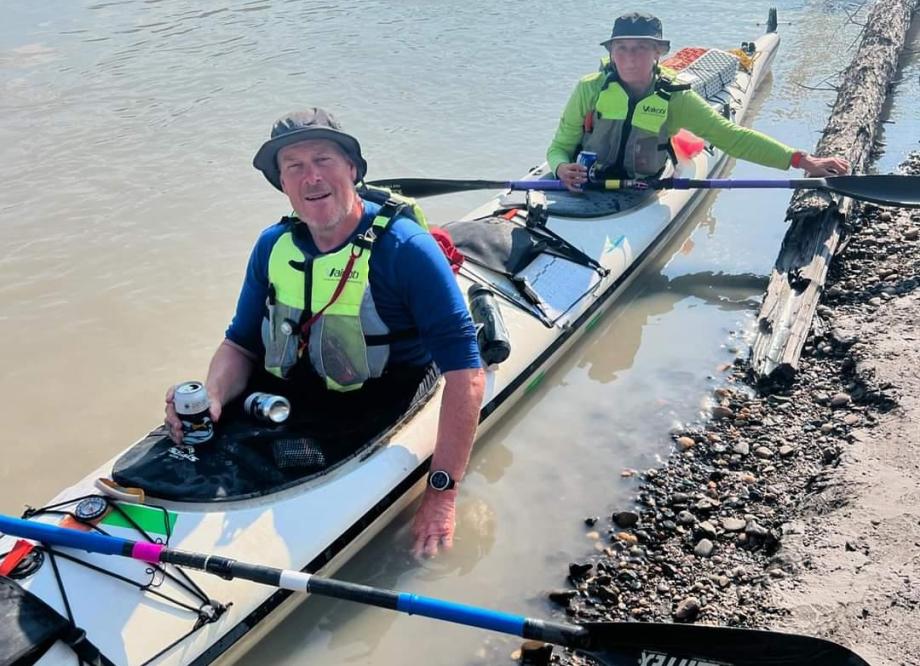
We’re standing beside our boat, which is almost completely packed with gear. Race Director Jon Frith is holding a phone up and recording our answer for a social media post.
Why are we standing on the start line of the Yukon 1000 in Whitehorse for the third time?
I deflect Jon’s question, “Bear bags are really expensive and this is the only way we can get our money’s worth”
We’ve already completed the event that most would consider to be a once in a lifetime endeavour. A challenge to “Push Past Impossible” as the tagline declares.
We finished 15th in 2024, in a time of 7 days 11 hours. A middle of the field (front of the back 3rd really) result that showed for us at least that it was quite comfortably possible.
So why are we here?
2024 had been an exercise in redemption.
We’d entered in 2023 and been forced to withdraw after wildfire smoke triggered debilitating breathing problems for me. From the front of the field to DNF1 in the space of 24 hours. Disappointing, humbling, and the cause of much soul searching when we returned home.
So we’d shaken ourselves off (coming back to finish the race had been one of Kate’s preconditions before she would accept I was unfit to continue), and we’d put together a plan. A conservative plan calculated to deliver a finish and expel the demons of 2023.
We spun a web of safe decisions. We bought a boat we could customise. We chose more reliable equipment. We erred on the side of completion over speed. And we finished, comfortably enough that we declared we could have continued down river for another 1000 miles if we had to – a tip of the hat to the proposed Yukon 2000.
And then we went home, with the t-shirts and the finishing medallions that had eluded us in 2023.
Then a few weeks later, when applications opened for the 2024 event, we put our names down again.
It is definitely not the norm to see teams or even individuals come back to the race after a finish. Often a team forced to withdraw will come back, as we did in 2024, to settle the score, balance the ledger, or exorcise the demons. Sometimes only one member of the team returns.
Teams that finish don’t normally come back the next year. It’s not that sort of event.
So why?
Our conservative plan had been based on safe choices. We set a target distance each day that would deliver us comfortably to the finish line in the middle of the 8th day. The fastest teams to finish in previous years have recorded astonishing times – 5 days 11 hours 48 mins is the record from 2022, a high water year.
6 days 23 minutes for the 2024 winners, Nathan and Sophie from NZ in a low water year. We split the time between them and the cutoff and set our sights on 7 days 9 hours. We broke the distance up into days and marked the map where we would hit our required distance each day. We didn’t push much beyond that point, except for the purpose of finding a better campsite. Better on the Yukon is highly subjective. Bear-less being the gold standard for better.
We were so comfortably inside our envelope that when we discovered I’d miscounted the day 5 distance by 50 km around Slaven’s Roadhouse, we just sat up and soaked up an additional 50 km without comment.
We arrived at the Dalton Bridge finish line 11 hours into the 7th day. Two hours off our target time.
When we got back home to Hobart, the one blister that wouldn’t go away was the knowledge that we’d finished too comfortably. We’d only had one day when we were under significant duress – day 4 from Dawson to Slavens Roadhouse where my shoulder caused us to pull up early. Otherwise, we’d kept enough in reserve to be left wondering what time we could have made if we’d gone harder.
But curiosity wasn’t enough to bring us back. The event is expensive, in terms of both money and the time invested in training.
So why were we back?
There’s a beauty to the Yukon River. Often it’s found fleeting glimpses sprinkled across miles and miles of rock and spruce trees2. There’s nothing beautiful about The Flats, which have all the appeal of The Desolation of Smaug. Sprinkle some rain and stir it with some wind and it has the aesthetic appeal of a colonoscopy. But there’s a memory that comes back before all the others when I think of the Yukon, from a valley north of Slavens with the morning mist lifting from the water to expose verdant islands reaching from the water into the low hanging layer of cloud. It was a moment of exquisite peace that was exclusively ours. That was beauty.
I have a photo of it, which doesn’t really do it justice because it can’t convey the scale, or the ambience (it was cold and damp), or the silence, but it does trigger the memory when I look at it.
For me, there’s an appeal in the isolation of the 1000. I spend my working life immersed in people, always on, always connected. The 1000 provides a forced disconnect from modernity. That’s an itch I can’t easily scratch in other parts of the world. Our home state of Tasmania is nearly 1/3 wilderness and protected areas, and yet you’re rarely more than a few hours from mobile coverage. The Yukon has provided my annual reset each year since 2023.
Still not an answer…
The finish in 2024 was followed by a void. We’d been preparing for the Yukon 1000 in one way or another since 2022. Our weekends were dedicated to paddling distances to maintain condition and preparations like mapping and refining our kit continued all year long. Returning home, there was a gap in our routine which had been filled by some aspect of the 1000 for nearly 3 years. We’d never really stopped to consider what we’d do next.
The Yukon 1000 is not the sort of challenge you sign up for without a reason to finish. Kate and I had been divided on that in 2023 and when things had turned bad for me in the smoke, my core motivation – doing it because Kate really wanted to do it – lacked enough substance to pull us through.
If you aren’t committed to finishing the 1000, you’re courting withdrawal. No matter how well prepared you are, proficient in skills, fit or strong. The event will throw something at you that will test your resolve and cause you to question your reasons for pushing through.
The hook, I think, is that it’s a challenge that Kate and I complete together, combining our individual strengths to overcome the challenge.
Tangentially at this point, I’ll note that only 3 of the 22 teams are married or some equivalent. A couple of teams are related – siblings or in-laws, one generational father daughter team. But for the most part it’s mates or acquaintances who have goaded or cajoled each other into entering a challenge together.
None of the above are never-fail recipes for speed over distance. That recipe would start with the best ingredients, two good paddlers who matched each other in the boat. A coach would pick their two best from a squad and put them in a boat to get acquainted.
It doesn’t start with the lad you went to school with, the girlfriend from university, the guy your sister married, or who you got drunk enough to ask out at university.
I’ve raced sprint and marathon against selected combinations and they are often hard to beat – at least in the sterile environment of short and middle distance racing.
But the Yukon is not sterile3. It’s wild nature that stretches to horizons you cannot see. Perhaps the relationships are what makes the difference out there where there is only you and the friend you’ve known for years. Maybe couples do have an edge in the wilderness.
Second tangent. Some teams start as strangers. Individuals who want to paddle the event, with perhaps only that desire in common. It doesn’t always end well.
Kate is one of the most relentless ultra-distance paddlers I know, tireless and unstoppable. She doesn’t complain, and has never conceded defeat in any event. By comparison, I’m a roller coaster of recklessness and self-doubt. She holds me when I’m swinging to my lows. I think I provide her with the emotional safety net to charge the big wave, or run the tighter cut. She plans the food, travel, accommodation and logistics of the campaign. I obsess about navigation and equipment. When we finish, it’s a team outcome. When we fail, it’s usually me. The better we execute as a team, the better we finish.
That’s the hook. To challenge ourselves as a team, a couple, partners, and to try to achieve more than we could as individuals. The better the result, the better we have worked as a team.
Why were we back? To push ourselves as a team, and as a couple, to see what we could achieve together.
“If you want to walk fast, walk alone. If you want to walk far, walk together.”
African Proverb
Help encourage more posts by buying Steve a coffee…
Choose a small medium or large coffee (Stripe takes 10% and 1% goes to carbon reduction)
Keeping it in perspective, I’d had breathing problems 300 km in at Carmacks and we’d self evacuated the 400 km to Dawson under our own power, still making it there before the cutoff time. ↩︎
 Rivers of Dust and Ash
One thought on “2025 Yukon 1000 – Preamble”