
Carmacks – Five Fingers – Rink Rapid – 7.5km past Minto
| Start Time: | 11/07/2025 04:39:17 |
| Location: | 61°45’52.4520″N 134°57’28.1160″W |
| Rest Time: | 06:04:27 |
There’s no room for social graces when it comes to exchanging warm dry clothes for wet paddling gear. The objective is to keep the dry gear – sleeping bags and thermals – dry despite the rain and other gear that is persistently wet1. I had no issue with stepping out of the tent starkers and pulling the wet gear on while standing in the rain. Afterall, who was there to see? Kate was more circumspect. I wasn’t and didn’t care. The Kiwi lads were still in their tent while this was happening.
Camping by ourselves is definitely our preference during the race.
We’d planned for 45 minutes of prep in the morning and had set two alarms. The first for 5h 15m as a wake up, and the second at 6h to get going. We took closer to an hour to prep and the Kiwis slipped away a few minutes ahead of us, but we were happy enough having only slipped 10 minutes and the few minutes of privacy were put to good use adding some nutrients to the local biome.
Day two would take us to Carmacks and into the two notable rapids of the river – First Five Fingers and then Rink.
The river meanders for the first half of the day into Carmacks and you spend much of the day paddling loops that aren’t taking you any closer to Carmacks. It’s one of those situations when you just want to concentrate on the river in front of you and not zoom out on your GPS to discover that you’ve paddled 30km to advance 15.
Although the rain had stopped overnight, the sun hadn’t risen enough to start warming the river. The startline at Whitehorse is already far enough North for there to be no darkness at night. We were now 200km north of there. By the time we reached Dawson in a day or so the sun would barely dip below the horizon at night. Closing in on Carmacks though, the rugged terrain on either side of the river banks blocks the early morning sun.
While we’d slept well enough, we hadn’t completely rebounded from being cold the night before and that cold start, together with the early morning shade was keeping us colder than we’d like to have been.
A subject that we’d contemplate several times over the following days was when to deploy the dry thermal gear. We’d both worn one of our two thermal tops on day one, rendering it saturated by the end of the day. The other thermal top was stowed in a dry bag in the cockpit. If you put it on in the morning, by night, you’ll have two wet tops which would both be horrid to put on. If you add it during the day, it will be wet as well. You would be warmer, because they were effective even when wet. It would be nicer though, to have it dry when you really want it. So you shiver a little and keep the dry top dry for later2.
Pants were a different story. We had packed one pair each. They were warm enough for all the conditions we could reasonably expect. With spraydecks on the boat they were good enough to keep us from hypothermia. There’s no such thing as a dry seat in a kayak, so a second dry pair would be pointless. They were bloody horrible to pull on in the morning, and I would drop mine in a bin at Dalton when we were done3.
Improvement: We’d tweaked out clothing for 2025. Last year we’d found that fleecy clothing that purported to by hydrophobic4 eventually just became watterlogged. This year we’d switched our pants to Vaikobi pants which were a mix of neoprene and lycra that didn’t hold any water. There is still some room for improvement on our upper layers5.
We’d woken up feeling pretty refreshed but somehow the cold was conspiring to make me sleepy. Not hypothermia sleepy, or even physically fatigued. It was a sort of malaise. All I wanted to do was pull over and lie on a grassy bank in the sun until it went away6. I was at the bottom of my energy curve and really didn’t care about the race aspect at that point. Kate was yawning in the back as well, but as always, she is determined to keep moving, pulling me along, willing or not.
Along with lacking enthusiasm for the paddling, I really lacked enthusiasm for an argument I couldn’t win with Kate, so I yawned and carried on.
It took a lot of caffeine pills to pull me through the malaise. I think I smashed through the equivalent of six espressos in 2 hours that morning. I contemplated breaking into my cache for day 9 which we carried but didn’t expect to call on. Then 600 milligrams of concentrated caffiene and guarana began to kick in. I didn’t seem to need more stimulants that day.
One of our successful innovations from last year had been honeycomb gel seatpads. I’d upgraded mine from a 1 inch pad to a 2 inch thick version. Kate had mocked me. On last year’s approach to Carmacks I’d been having significant seat pain. Ultimately, I resolved it by lengthening my footrests, but it had set me up for seat pain for the entire race. I’d still had trouble sitting for the 15 hour flight home from Vancouver to Sydney.
This year my gel seat was working really well. I had no discomfort for the entire race and the flight home was unmemorable. Kate on a thinner seat (I bought her an upgrade for Xmas. She left it at home) was good until early on day 7. By the time we finished, she’d rubbed two holes through the silicone.
By the time we reached Carmacks (300km) we were starting to feel normal. The sun had come out to warm us and the enthusiasm was starting to flow again.
Now that the river was calm and flat, the Passat’s rough water advantage was turing into its Achilles’ heel. On flat water it is fat and slow, meaning we would have to work harder to keep up with the slippery WK640s.
The Little Duckers (team 8) had slipped past us unnoticed some time early in the day, and we’d come up behind them again not long after Carmacks. Most of the time they were pushing their boat along quite effectively, good form, good sync, good cadence. But then they’d pause and we’d pass them again. They told us they’d had a rough time on the lake and all of their dry gear was wet, so they’d slept in wet gear the first night.
They were paddling with their down jackets wrapped around their heads, attempting to dry them out. Over the next few days, we’d be treated to a parade of their entire fashion collection. They were quite keen on hi-viz and flouro. I’m not sure whether they ever got all of it dry, or even dry enough to be comfortable. There were several occasions where, just as something looked dry, the heavens would burst and they’d be deluged again. For a time they’d spread gear on the back deck to dry. That just seemed to invite more rain. We were having the same problem with our extra thermal layers.
They seemed to stop quite a lot. We whiled away the hours speculating on why.
Our strategy is to stay in the boat and keep it in the current when we weren’t actively paddling. That meant we ate in the boat, changed clothes in the boat, and peed in the boat. It was another reason why we favour the Passat. Being a little wider, there’s enough stabilty to pull a jacket over your head, and enough room to pee.
[When I say pee in the boat. We don’t actually pee in the boat. Ewwww! We pee, in the boat, into a bottle. Glad we’ve cleared that up]
One of the most uncomfortable things you can do in a kayak is pull a jacket over your head on the water. Whether you take off your life jacket to put it on, or have a jacket that’s oversized enough to pull over your lifejacket, there’s always a point in the manouvre, when your arms are trapped in the sleeves and your head is pushing towards the neck hole, that you know a capsize would be very problematic. That’s when you want a stable boat.
The other notable thing about The Duckers was their music, playing loud from a waterproof speaker.
It wasn’t that it was apallingly bad doof doof clubbing music. They claimed it was a random blend of tunes from both of their playlists. It was that it was a completely different beat to their paddle cadence. My brain was exploding trying to match the doof doof doof to their paddle paddle paddle. Still they were pulling away from us most of the time, so it worked for them.
Hot Tip: Sea kayak compartments are rarely watertight, and the boats in the racing fleet have had enough use that they can all be expected to leak from cracks, bulkheads, rudder cables, or hatch covers. Assume the bulkheads will take on water. As much as possible use many small bags as you can to limit the impact of leakage.
Hotter tip: When you pack your dry bags in the hatch. Stand them up so the roll tops are not down in the bilge.
Improvement: Last year we discovered Nite Ize Runoff dry bags which use water proof zip closures. They are expensive, but so far they’ve been outstandingly reliable. We double bagged our satphone, but our normal mobiles and other electronics went the distance in a less than watertight hatch in a Nite Ize.
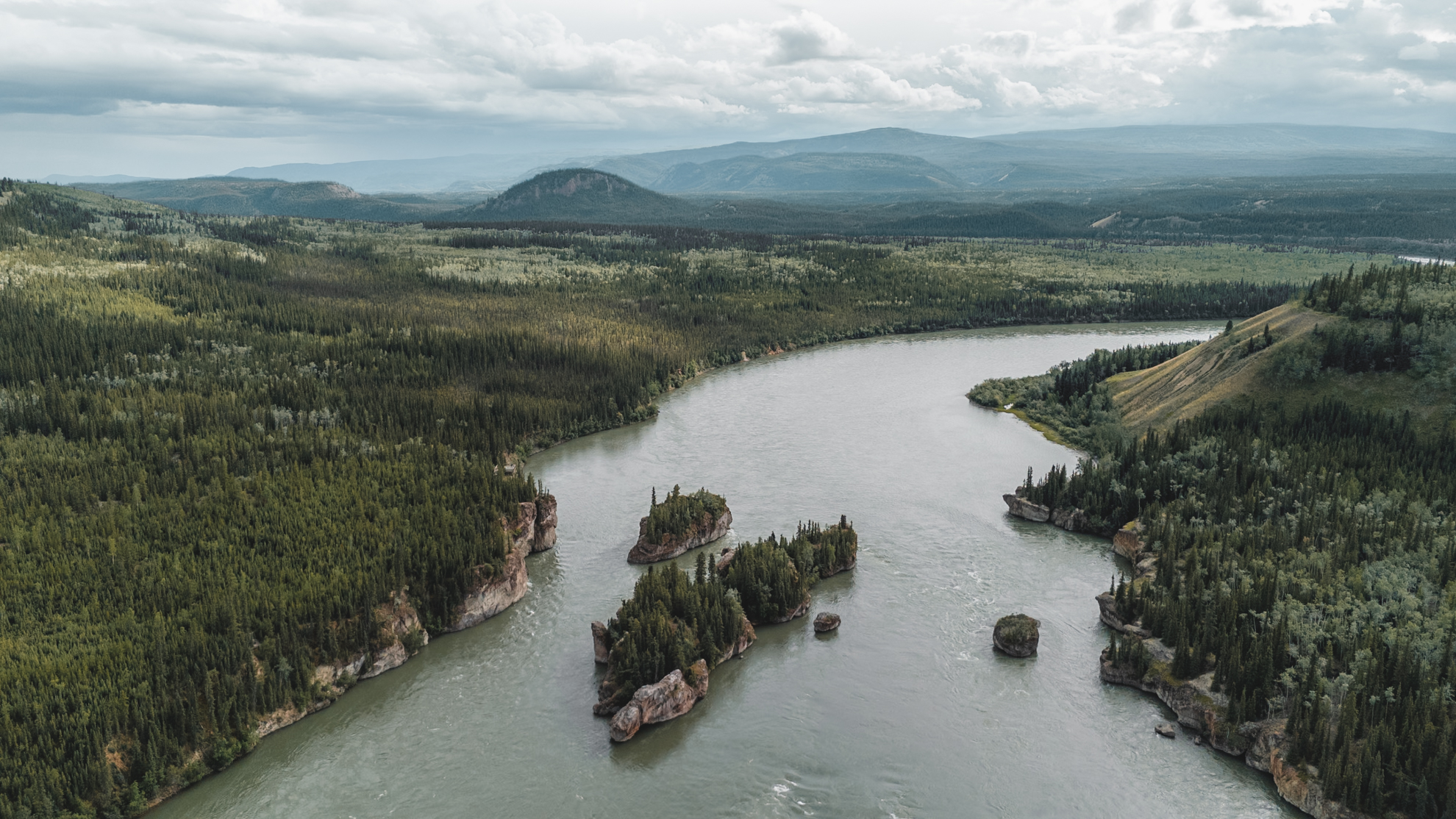
We played cat and mouse with the Duckers for most of the afternoon. The Duckers would take a wide line to stay in the current and we’d take a shortcut, generally popping out of a side channel some way ahead of them. They were probably the faster boat, but we were holding our own with cunning and knowledge of the river.
In 2023, we’d been paddling this section after deciding to withdraw and we’d used that as an opportunity to paddle some of the sketchier shortcuts along the river. We’d found that some were good and others were shallow or obstructed. We were applying that now to good effect.
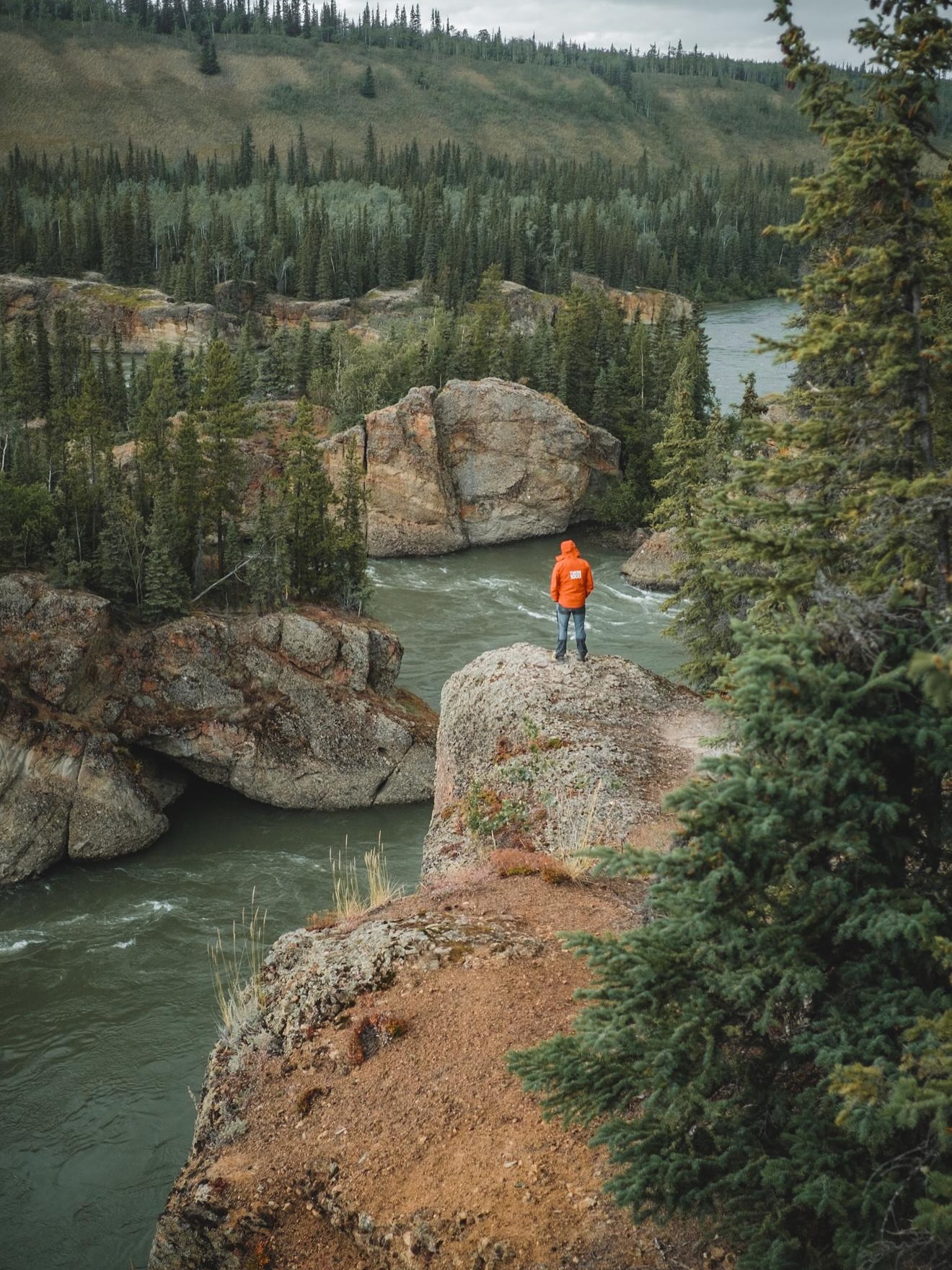
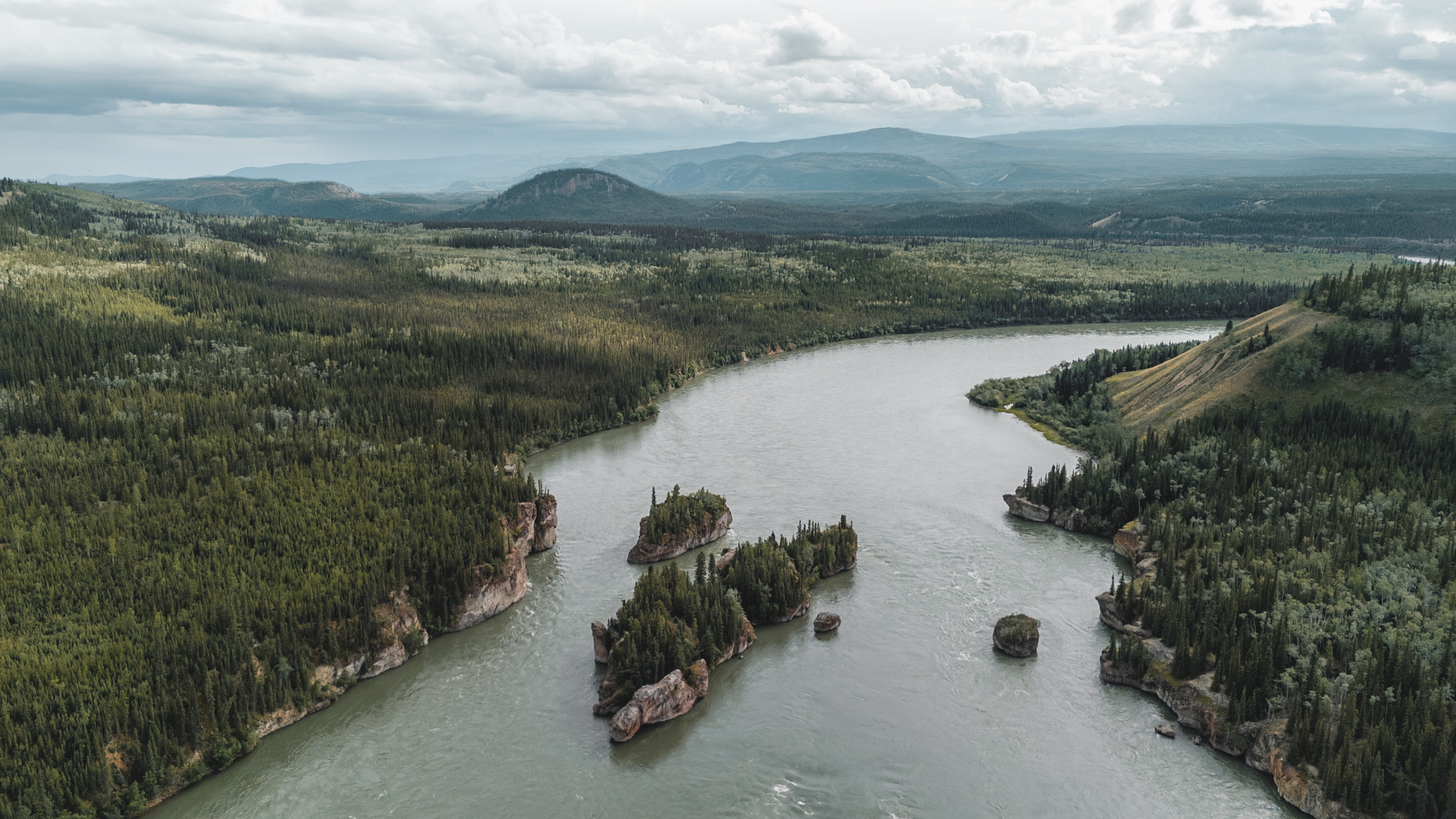
Five Finger Rapids was a bit more energetic than previous years. Normally it’s a quick ride down a tongue of water into 3-4 standing waves that barely break over the deck. This year that extended to about a dozen waves and then a side wave that was coming in from the right hand side.
The Duckers had asked for any tips on Fiver Fingers and I offered my standard, “Just keep paddling”. It’s good advice for 90% of situations. Not paddling is a uniformly bad strategy in almost every occasion.
We’ve never considered Five Fingers to be particularly difficult. Most of the trepidation comes from Jon on the cliff overlooking the river with a camera, waiting to immortalise any evidence that you had exceeded your allocation of luck or talent for the day. This year there was also a drone. Double jeopardy.
This year we were rewarded with some drone footage of us going through Five Fingers, completely out of sync with each other7.
After Five Fingers, another rapid called Rink has what I think is an entire unwarranted reputation. Of the four times we’ve been down the river, this was the first time I can say I could actually distinguish it from the rest of the river.
Other paddlers will say to keep hard right, but as out team name suggests I’m a little challenged by the details of left versus right and going left or right seemed to involve paddling quite a bit further, so we went straight down the middle where I got admonished by Kate for splashing water over the deck where she was trying to dry off her reserve thermal top. It wasn’t a big splash.
Having now squandered all the opportunities for excitement, we continued on downstream towards Minto.


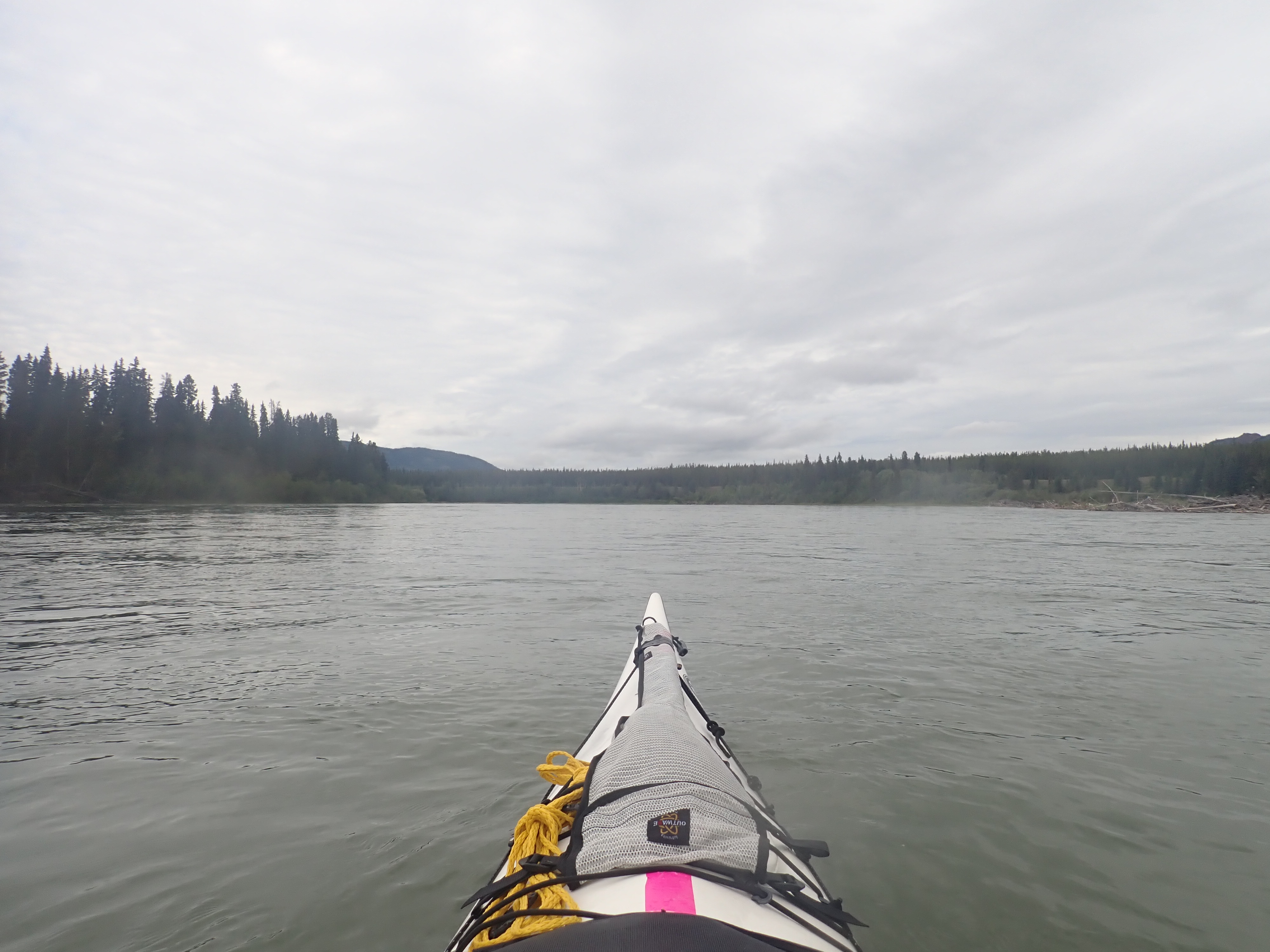
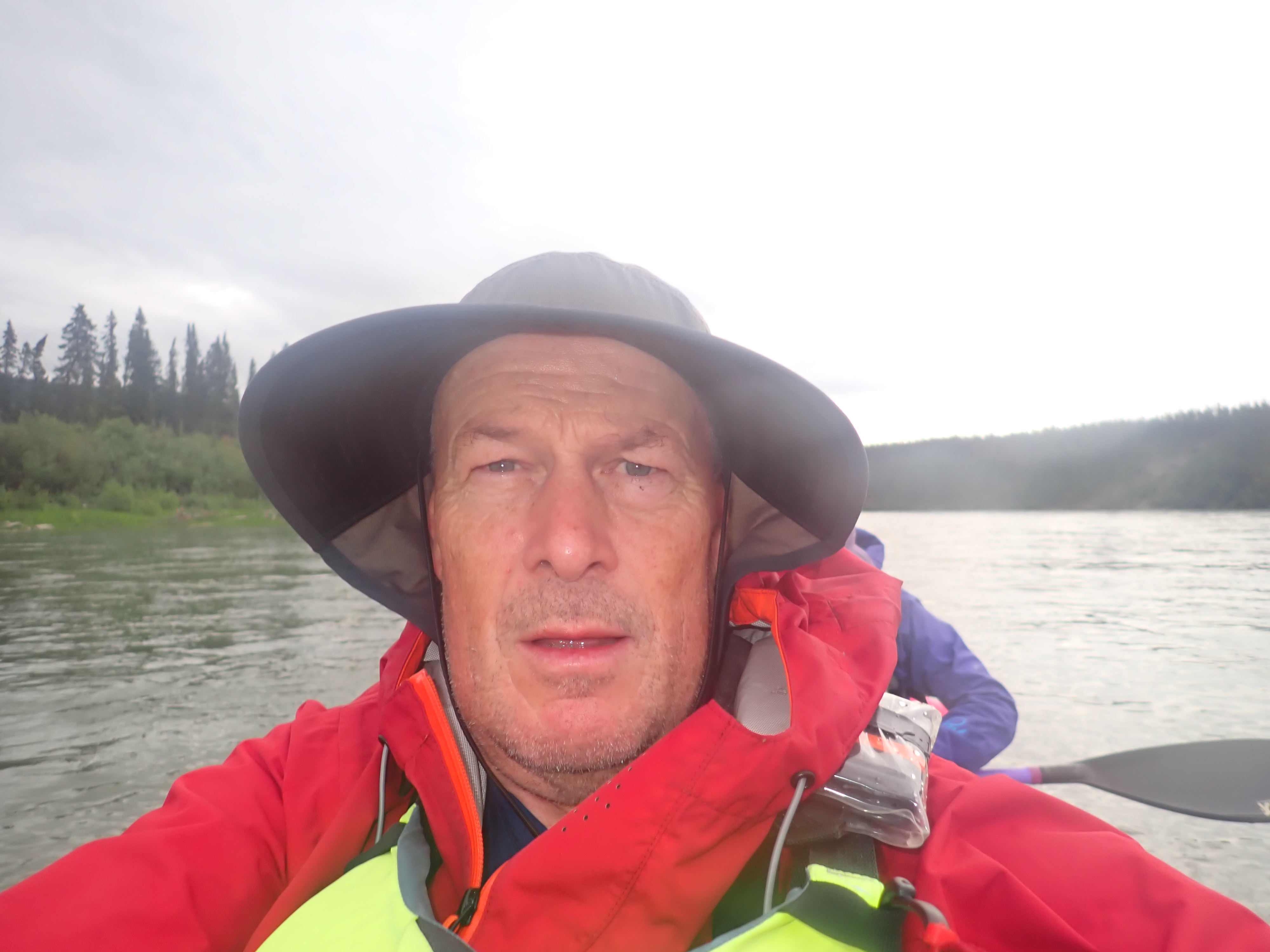
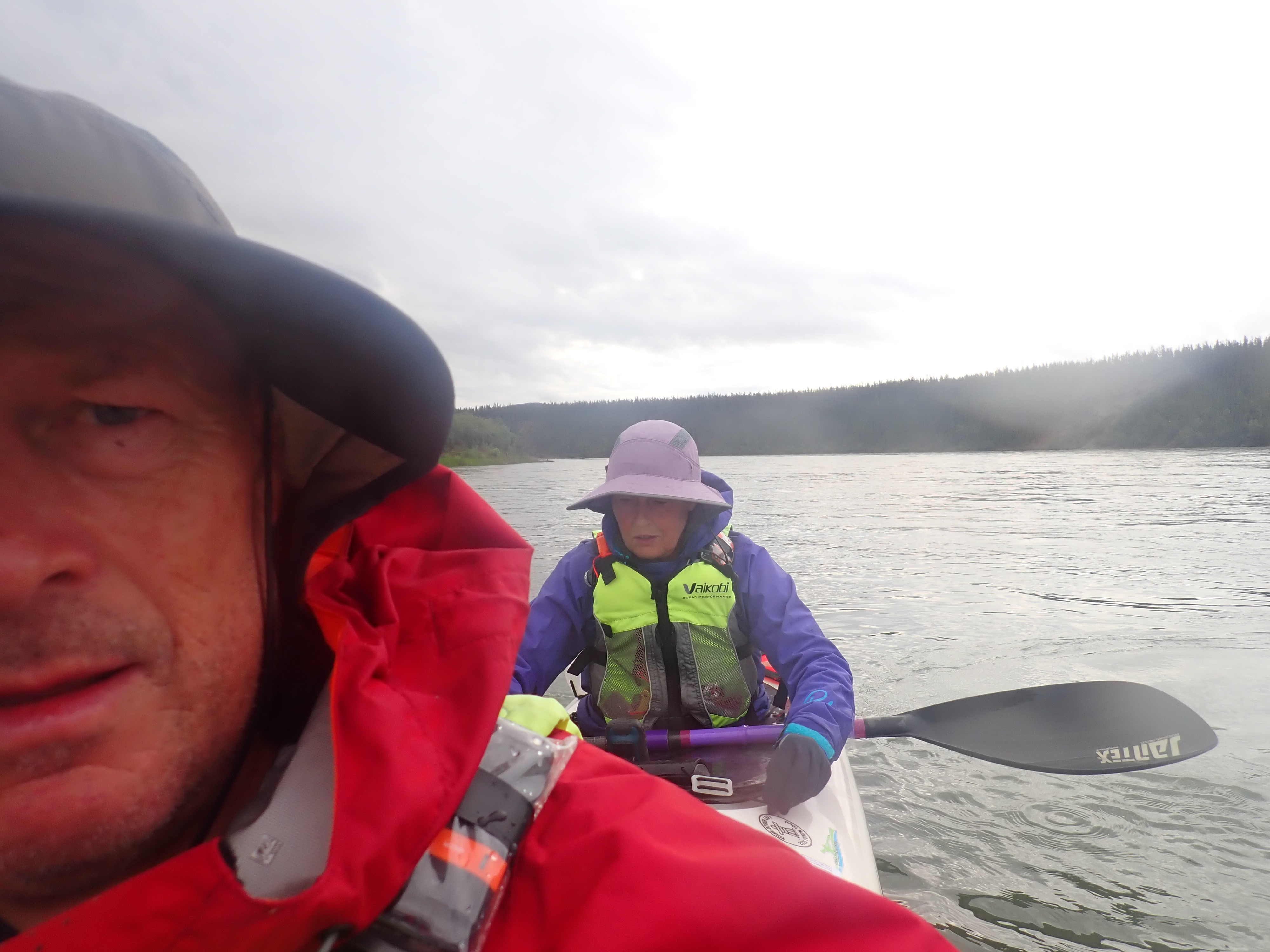
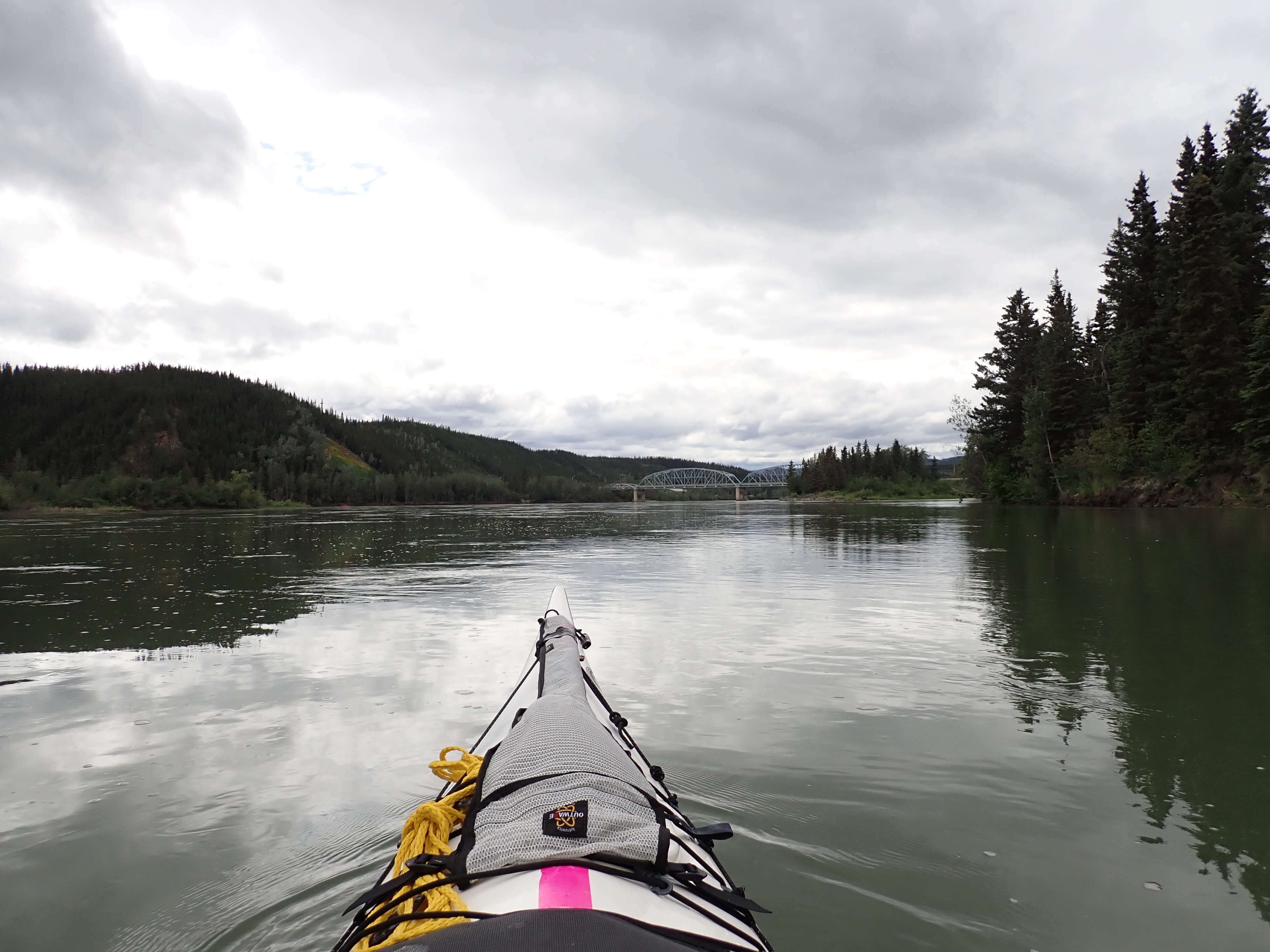
To stave off boredom, we ran a few of the alternate routes we’d mapped to see how they would fare against the main flow route The Duckers were running. It was a mixed bag, which served to keep us amused and alert.
We laid a particularly big bet on a shortcut late in the day, emerging a few kilometres later to find no sign of The Duckers in front or behind us. We figured we lost on that one and they’d gotten away from us.
Last year, we’d camped up a couple of kilometres past Minto, having observed a huge plume of smoke rising from the hillside 20-30km further downriver. It had been earlier than the stopping window, but the prospect of stopping within a stones throw of a developing wildfire was a worse option when we added the effect smoke has on my breathing and the propect of sparks landing on our tent while we slept.
We’d also previously relied on the Rourke touring guides to mark out viable campsites on our maps. They are the bible of Yukon River touring, but in that description lies the flaw8. Rourke considers anything which isn’t a grassy meadow with shelter and level sites to be unusable. We’d made that mistake last year and been fairly disgusted to find there were endless race-viable campsites that Rourke didn’t mention. Based on Rourke’s grading, we’d ventured into a winding backwater in search of campsite. We’d found a site, but we’d done an extra kilometre winding our way back to the river in the morning.
It was around 10pm when we pulled up on an island that was looking vaguely hospitable. The mapping for the next hour downriver looked to be devoid of island camps and we’d been pushing quite hard trying to see if we could catch up The Duckers who we still assumed to be somewhere in front of us and going well. Maybe we pushed a little harder than we should have.
It turned out that The Duckers had been just out of sight on the river behind us. They paddled past us looking for camp sites as we were setting up our tent and spreading our clothes out to dry.
Again, the frequent flyer advantage allowed us to go straight off to sleep. While we were still being selective about campsite locations to avoid wooded areas, we were largely unphased by the possibility that there might be a bear in the night. We still slept with bear spray beside our pillows.
Further back in the pack Team 3 Untapped had withdrawn after a capsize on the lake and then another on the river which had included some hard contact between paddler and kayak. The race was down to 21 teams. We wouldn’t know about this development until we finished at Dalton Bridge.
We were feeling pretty good. No blisters. A little wrist strain, probably attributable to the duelling with The Duckers.
The most prominent problem for me was some abrasion which had developed on my sides from the rim of the cockpit. I’d noticed some rubbing earlier in the day, which is when I should have addressed it. As we’d pulled up to camp I realised that the back of my seat wasn’t connected and I’d literally been grinding my back into the cockpit for the last two days. I’d broken skin in a few places and would need to manage9 it carefully for the next week.
| End Time | 11/07/2025 22:01:14 |
| End Location: | 62°37’45.1200″N 137°0’52.2000″W |
| Altitude: | 464.0 m |
| Distance: | 226 km |
| Paddling Time: | 17:14:30 |
| Non-moving time: | 00:00:22 (no time on land) |
| Average Speed: | 13.1 kph |
| Max Speed: | 19 kph |
| Race Position: | 7th (down 1) |
Help encourage more posts by buying Steve a coffee…
Choose a small medium or large coffee (Stripe takes 10% and 1% goes to carbon reduction)
Or enter a custom amount
Your contribution is appreciated.
Donate- Another reason for a more spacious tent is that you can stay away from the walls when the inner inevitably gets as wet as the outer. Our Helleberg Staika has plenty of room inside, two vestibules that act as wet rooms, and a footprint that extends into the vestibules so you can step out of muddy shoes onto a (less muddy) footprint before slipping into the tent. Under normal camping conditions, we would have separated the dry inner from the wet outer when we took the tent down, packed them separately, and had a dry inner the following night. For a race, that’s 20 minutes we could use for sleep. For 6 of our 7 nights the tent was soaked through. ↩︎
- This also applies to smell. The longer you keep a garment in reserve the better it will smell (relative to you.) ↩︎
- We’ve given up buying new gear for the race. Largely we turn up in gear we’ve used in training all year and then dump some of it into a bin at the finish. The friction from the 1000 miles of paddle strokes has been the coup de grace for several new thermal tops, spraydecks and lifejackets, so now we take the old kit ↩︎
- Hydrophobic is literally afraid of water, which in humans is a symptom of rabies. That Hydrophobic clothing is a wank-word phrase made up by some marketing wonk is a hill I choose to die on. ↩︎
- maybe 2026 ↩︎
- The irony at this point in the story is that having spent the night on what we were convinced was the only hospitable grassy campsite for the entire 1000 miles, there were grassy spots everywhere I looked. These would be the last inviting spots for the next 6 days. ↩︎
- Technically, the bow paddler is never out of sync because they can’t see the stern paddler behind them. It is the job of the paddler in the back to stay in time. If questioned however, I was paddling out of time in the bow on the drone footage. ↩︎
- pre-race, some other teams had noted they were using Rourke’s guide books. I felt no obligation to discourage them. ↩︎
- Managing an abrasion on the 1000 is not easy. In this case, I used dry powder antiseptic to keep it sterile (this stuff is amazing. It goes on as puffed powder, so you don’t have to touch the wound area and tape sticks to it because it’s not an ointment). I then applied breathable tape over it during the day to buffer any ongoing abrasion. [Graphic description follows] Over the next few days the movement of the tape against my skin would further aggravate the edges of the area. Then the weeping wound would be sticking to my bedding in the morning. The moral of that story is that these are the sort of problems you should avoid, even if it means stopping the boat to get out and adjust something. ↩︎
 Rivers of Dust and Ash
You write very well. I am so enjoying the expanded version of the paddle.
LikeLike